Umbrella Logo Placement Strategies for Different Brand Goals
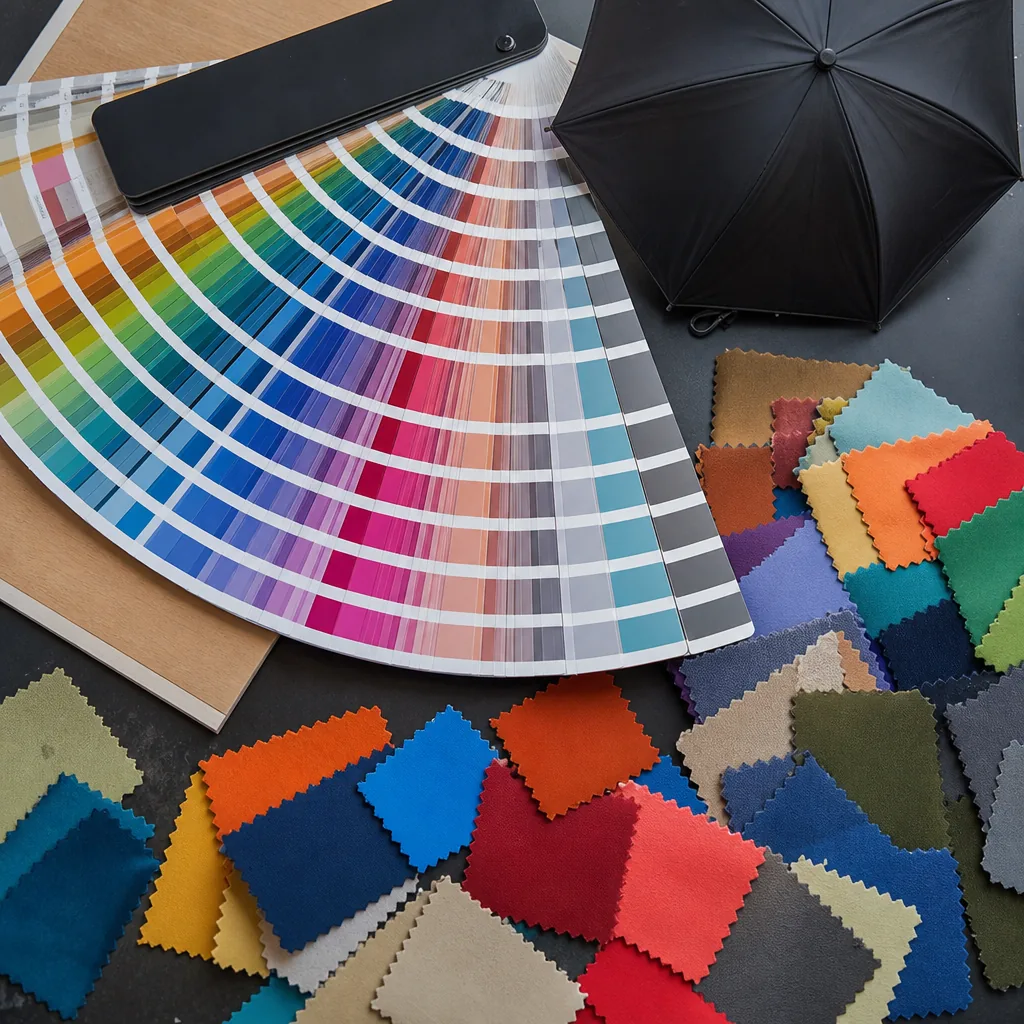
A branded umbrella can look correct on a mockup and still fail on the street if the logo lands where folds, ribs, handles, or viewing angles work against it. On our factory floor, umbrella logo placement is decided together with panel layout, print method, canopy color, and how the buyer expects the umbrella to be used after delivery. The right position can improve visibility, perceived value, and repeat use; the wrong one turns a useful gift into forgettable stock.
Brand goals determine where the logo should sit
Choose umbrella logo placement by the buying goal, not by the empty space on the canopy. Event giveaways need fast recognition at walking distance, so a one-panel mark or two opposite-panel repeats on a 23 inch auto-open model usually beats an all-panel print. The logo appears as users move through race days, campus events, and conferences without turning the umbrella into a billboard. On 190T pongee, a 7 to 9 inch wide screen print fits most standard panels when the art leaves seam clearance and avoids rib interference. On POE clear umbrellas, keep the imprint lower on the panel so the user’s sight line stays open. Opposite-panel repeats improve side exposure in crowds; a single centered panel works better for posed group photos because the mark reads cleanly when the canopy faces the camera.
Retail programs should start with shelf display, folded presentation, and ecommerce photography. A centered panel logo can look strong in product images, but it can disappear in store if the sleeve covers the printed panel or the umbrella is packed with the mark facing inward. For branded rain umbrellas sold in trays or on pegs, one outside panel imprint plus a woven label or handle badge gives the buyer more reliable brand visibility. This matters on 21 inch compact auto-open-close umbrellas, where the canopy imprint area is smaller and panel curvature can distort tall artwork. Print alignment is also a retail quality risk: if the logo baseline is not parallel to the rib line, the error repeats across every unit in the display and looks like a production defect.
Corporate gifts need restraint because the recipient is expected to use the umbrella repeatedly. A 27 inch golf umbrella with double-canopy venting can carry a larger mark, but one centered panel logo or a subtle opposite-panel repeat is usually more appropriate than printing all 8K panels. For promotional umbrella branding, the tradeoff is practical: walking visibility favors repeated side exposure, photos favor one clean front-facing panel, and shelf display favors a mark that remains visible when the umbrella is folded, sleeved, or hung from a peg. ZheBrella confirms placement on a strike-off before bulk production, checking rib position, seam clearance, viewing angle, Pantone color, and print alignment before approving the run. That review reduces rework risk before the order moves into mass production.
Match placement to umbrella construction and panel count
Panel count controls usable canopy imprint area more than the open diameter. On a standard 8K canopy, each wedge is wide enough for a single-panel mark, typically 180-240 mm across on a 23 inch straight umbrella and larger on a 27 inch golf umbrella. That format suits bold wordmarks, event names, and distributor logos that must read from 10-20 feet away. A 16K canopy creates a rounder, more premium silhouette because the ribs sit closer together, but each print zone is narrower. A horizontal logo on 16K usually needs to be reduced, repeated on alternating panels, or engineered to cross seams. For branded rain umbrellas, two opposite 8K panels often give better visibility than forcing a wide mark into a 16K wedge where letters taper toward rib lines.
Seam lines are the main production risk in umbrella logo placement because they combine folded fabric, stitch tension, and a raised ridge. Screen printing across a seam can break thin strokes; heat transfer can show pressure shadows after repeated opening and closing. Sublimation on white pongee supports complex artwork, but print alignment still needs panel-by-panel control because fabric is cut before sewing, and 2-3 mm sewing variance is obvious when circles, borders, QR codes, phone numbers, or social handles cross multiple seams. Straight panel geometry protects legibility: center critical artwork inside one wedge and keep at least 15-20 mm clearance from seam stitching and rib pockets. Curved layouts can work only when the file is built to the canopy pattern, not copied from a flat banner.
Frame material changes how promotional umbrella branding reads after assembly. Steel ribs hold a firm, predictable arc on approval samples, so canopy tension looks stable when new; after transport damage or wind use, one bent steel rib can distort a panel permanently and make the logo appear off-center. Fiberglass ribs flex under gusts and recover better, especially on 8K and 10K windproof frames, but that movement changes canopy tension during opening, closing, and wind loading. On double-canopy vented umbrellas rated around 50+ mph in wind-tunnel testing, the upper and lower canopies move separately, so large logos near the vent edge need extra clearance. Approve artwork on a sewn pre-production sample, not only a digital template, because rib bow, runner height, seam take-up, and fabric stretch decide whether the final print looks square when open.
Specify artwork size, clearance, and safe zones
Specify artwork in millimeters so the factory can build a production dieline, not interpret “large logo” or “centered.” On a standard 23 inch, 8K rain umbrella, keep a single-panel mark at 180-220 mm wide. On a 30 inch golf umbrella, use 240-280 mm only for simple shapes with limited text; wide lockups with taglines will drift toward rib valleys and look off-center after sewing. On a compact 21 inch folding umbrella, limit the mark to 120-160 mm because the tighter canopy curve exaggerates print alignment errors. For reliable umbrella logo placement, hold artwork at least 25 mm from stitched seams and 35-45 mm from the outer hem. On double-canopy vented windproof frames, keep 50 mm or more from the vent overlap so the top canopy does not cover the mark during opening or wind flex.
Build safe zones into the dieline because umbrella panels are sewn under tension, not printed as flat signs. Bias stretch, rib pressure, crown angle, and panel handling all affect final position, so artwork approval should state imprint tolerance: typically +/-3-5 mm per panel for screen print or heat transfer on pongee 190T or 210T. Sublimation on cut panels can register tighter before assembly, but stitching can still shift the final location. Add 5-8 mm panel bleed for pre-assembly printing, especially for edge-to-edge graphics or patterns crossing multiple panels. A production-ready canopy imprint area should mark seam clearance, vent clearance, crown exclusion, and hem exclusion before sampling. First-article inspection should then check position, skew, and seam color contamination under the agreed AQL 2.5 plan.
Avoid fine text and thin strokes unless the imprint area is large, high-contrast, and away from rib valleys. On 190T pongee, the slightly more open weave can soften type below 8 pt, strokes under 0.35 mm, and reversed white lettering after ink penetration or heat press pressure. 210T pongee gives cleaner edge definition, but it still will not reproduce like coated paper; Teflon water-repellent finishing, dark fabric, wet movement, and repeated folding all reduce sharpness. For branded rain umbrellas, keep the canopy mark bold and simplified, then move URLs, legal lines, QR codes, or campaign copy to the sleeve, hangtag, or woven label. Strong promotional umbrella branding comes from a logo size and clearance plan that survives stitching, folding, and repeated opening without looking crooked.
Choose the right decoration method for each placement
Choose the decoration method by logo size, color count, fabric, and canopy imprint area before approving artwork. Screen print is the safest bulk option for 1-3 color logos on 190T or 210T pongee: the ink film flexes through folding, keeps unit cost down for branded rain umbrellas, and suits lower canopy panels, simple tie-strap marks, and other repeat positions. Its limits are predictable: fine type, gradients, photo detail, and metallic effects soften on woven texture. Digital print fits large canopy graphics, full-panel artwork, gradients, and multi-color logos, but it needs stricter print alignment across seams and ribs because each panel curves after stitching. Heat transfer works best for small chest-style marks on sleeves, tie straps, and lower panels where sharper edges or metallic effects matter, especially on short runs that do not justify separate screens.
Umbrella logo placement becomes more sensitive when the frame changes canopy tension after assembly. Auto-open and auto-open-close umbrellas use a spring-loaded runner that snaps the canopy tight; heavy transfer films near fold lines can crack earlier during cycle testing. On POE, PVC, and EVA canopies, reduce heat-transfer temperature and dwell time because these films can deform or haze under heat that 210T pongee normally tolerates. Windproof double-canopy styles add a separate production constraint: the upper and lower canopy layers must vent air, so transfers should not bridge the vent overlap, and large digital graphics should stay below the vent seam. For promotional umbrella branding, ZheBrella checks first-article print alignment on a fully assembled sample, not only on flat fabric, before bulk release under AQL 2.5 inspection.
Lock the placement in the approval and sampling stage
Lock umbrella logo placement before bulk fabric cutting because sewn panels change the final print position. Require a ruler-marked approval sheet for each marked panel showing four values: distance from the nearest seam, distance above the hem, finished logo width and height, and orientation relative to the handle when fully open. For an 8K 23-inch stick umbrella, a common single-panel logo sits 90-120 mm above the canopy edge and centered between ribs. On 10K or 16K frames, narrower panels reduce the usable canopy imprint area, so the same artwork may need resizing. Ask for straight-overhead and user-facing photos of the open sample, not only flat artwork, because sewing tension can pull 190T or 210T pongee enough to make a centered mark look tilted. For vented double-canopy windproof umbrellas, check both the visible top layer and the lower vent overlap so the logo is not partly covered when the canopy lifts in wind.
Separate color approval from layout approval. A PDF can confirm size and position, but it cannot prove ink behavior on 190T or 210T pongee, POE, PVC, EVA, Teflon-treated waterproof fabric, or UPF 50+ silver-coated fabric. Request a physical strike-off that lists the Pantone target, print method, fabric specification, coating note, and curing result. Screen printing, heat transfer, and sublimation each shift color differently, especially on black, navy, and red panels. Inspect print alignment with the umbrella fully open, then repeat after three open-close cycles on the relevant mechanism: manual, auto-open, or auto-open-close. Finished samples should pass AQL 2.5 inspection logic for logo position, color tolerance, adhesion, smearing, skipped stitches near the printed panel, rib symmetry, and handle orientation before bulk production is released.
Late artwork changes affect MOQ, lead time, and shipping cost, not just the file name. Moving from one panel to two opposite panels, exceeding the approved canopy imprint area, or changing from one-color screen print to heat transfer can raise MOQ because films, screens, setup, or transfer sheets must be remade. A typical custom umbrella schedule of 25-35 days after sample approval can add 5-10 days for re-proofing if promotional umbrella branding changes late, which may also miss the booked vessel date. Under FOB terms, the buyer carries the port-handoff schedule risk; under DDP, the landed price can increase if the delay forces air freight, split shipment, or revised customs paperwork. For branded rain umbrellas tied to an event or retail launch, the signed approval file should freeze artwork version, panel number, logo size, print position, Pantone color, mechanism, fabric, and packaging, with any change restarting sample approval.
Frequently Asked Questions
What placement is usually safest for a first-time branded umbrella order?
A single-panel logo with generous clearance from the seams is usually the safest choice. It is easier to approve, prints cleanly on most canopy materials, and reduces risk when the frame or panel count changes.
Can the same logo placement work on both compact and golf umbrellas?
Not reliably. Compact umbrellas usually need tighter artwork and smaller print zones, while golf umbrellas can support larger, more visible placements because the panels are wider and the canopy has more usable area.
Which umbrella logo placement is best for retail resale?
For retail resale, a small outside-panel logo or woven label on the strap usually feels more premium than a large centered promotional mark. Many retail brands keep the canopy logo within 10-18 cm wide on one or two panels to maintain a clean shelf-ready look.
Can the logo be printed across two umbrella panels?
Yes, but cross-panel printing requires careful print alignment because the seam and panel curvature can break the artwork. For bulk OEM orders, factories usually recommend a pre-production sample and allow a 2-5 mm alignment tolerance depending on fabric, frame size, and print method.
What logo position gives the most visibility for giveaway umbrellas?
For promotional giveaways, one large logo on alternating canopy panels gives better street visibility than a small handle or strap mark. A common approach is printing on 2 or 4 panels, with artwork sized to fit the safe imprint area and positioned away from ribs and seams.
Looking to Launch Your Custom Umbrella Line?
ZheBrella is a Zhejiang-based OEM/ODM umbrella manufacturer with 17 years of export experience. Free design, low MOQ from 100 pieces, windproof construction, full-color print.
Get Free Quote Now »People Also Search For
Related Articles
Top 5 Logo Size Decisions for Branded Umbrella Panels
Plan logo size by umbrella type, panel count, print method, and buyer approval needs before sampling branded umbrella or...
Read More »Refined Logo Placement Specs for Branded Umbrella Canopies
Plan logo placement on umbrellas with clear specs for panel size, safe zones, seam breaks, and repeat-order consistency ...
Read More »
Logo Scaling on Folding and Golf Umbrellas for Brand Teams
Set practical logo sizes across folding, stick, and golf umbrellas while accounting for ribs, panels, print methods, mec...
Read More »