Reflective Safety Umbrellas: Buyer Guide for Night Visibility
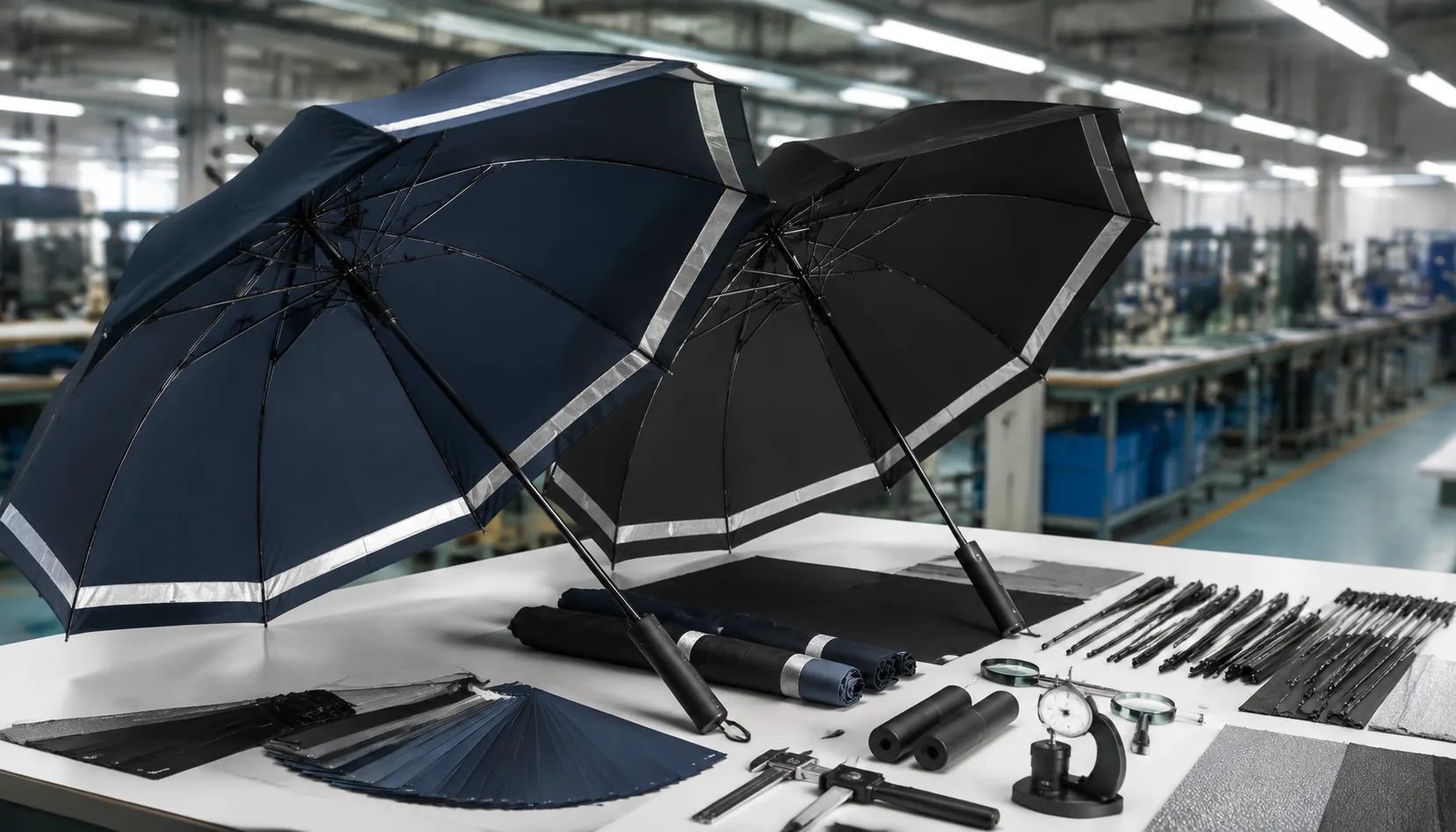
Night-visibility programs fail when the umbrella looks reflective in a sample room but loses impact after rain, folding cycles, and carton compression. For reflective safety umbrellas, buyers need to lock down trim width and placement, canopy coating, rib strength, reflective test standards, MOQ logic, and packing before artwork approval. On our Songxia production floor, these details decide whether a commuter, campus, or event order ships as a safety tool instead of just another giveaway.
Visibility Features Buyers Should Specify
The first specification I check on reflective safety umbrellas is not the logo; it is the angle coverage. A narrow reflective strip on one front panel looks good in a catalog photo but disappears when the user turns sideways at a crosswalk. Buyers should specify reflective piping around the canopy perimeter, reflective edge binding on at least 70–100% of the outer circumference, or segmented panel tape on alternating ribs so headlights catch the umbrella from front, rear, and side angles. For most 23" and 27" straight umbrellas, 1 cm trim is the minimum I would accept for commuter use; 1.5–2 cm is better for event staff, school routes, or roadside promotions. On compact 21" auto-open-close models, keep reflective tape slightly narrower so it does not stiffen the folding seams or cause puckering during canopy closing.
Material contrast matters as much as the reflective film. Silver-gray reflective tape on black 190T or 210T pongee is the strongest all-around choice for night commute umbrellas because it gives both daytime contrast and nighttime return under headlights. On navy, burgundy, or forest green canopies, I prefer white or fluorescent yellow edge binding rather than tone-on-tone decoration. For high visibility umbrellas used by delivery teams or construction-adjacent staff, orange, lime, or bright yellow panels with reflective piping give better recognition before the reflective layer even activates. PVC or POE transparent umbrellas need a different approach: reflective edge binding and rib-tip markers work better than wide panel tape, because tape on clear film can look cloudy and may stress the welded or sewn edge over repeated opening cycles.
Logo placement should never interrupt the safety geometry. For safety promotional umbrellas, keep the brand mark inside one or two panels and away from the reflective perimeter; a large dark heat-transfer logo printed over reflective tape defeats the purpose and often fails abrasion testing. If the logo must be visible at night, use a separate reflective logo print, typically 8–15 cm wide on a front-facing panel, while leaving the 1–2 cm trim continuous around the edge. Our standard practice at ZheBrella is to review reflective placement on an opened sample under low light and angled flashlight, not just under factory lamps. For production approval, ask for photos from 0°, 45°, and 90° angles, plus an AQL 2.5 check for tape adhesion, skipped stitching, and edge-binding alignment after opening and closing 20 cycles.
Canopy Fabric, Coating, and Print Options
For reflective safety umbrellas, I usually steer buyers toward 190T pongee when the project is price-sensitive and toward 210T pongee when the umbrella must look retail-grade under close inspection. A 190T pongee canopy is lighter, packs well on 21" and 23" folding models, and still sheds rain properly when finished with a good water-repellent treatment. The tradeoff is hand feel: it has slightly more light transmission and less body, so large solid-color logos can show minor panel waviness after sewing tension is applied. A 210T pongee canopy feels denser, holds a smoother dome on 23", 27", and 30" frames, and gives cleaner edge definition for corporate logos. On the cutting table, 210T also behaves better because the fabric shifts less during stack cutting, which helps keep reflective piping and panel seams aligned.
Print sharpness depends as much on coating choice as fabric count. Screen printing is still the workhorse for 1- to 3-color safety promotional umbrellas because it gives strong opacity on navy, black, orange, and fluorescent yellow panels. Heat transfer is better for small QR codes, gradients, or event artwork with tight registration, but buyers should confirm wash and fold durability because thick transfers can crease near rib tips. Sublimation works best on white or light 190T/210T polyester pongee; it gives excellent detail but cannot produce bright artwork on dark canopies. For a reflective trim umbrella, keep logos away from seam lines and reflective tape by at least 15–20 mm, otherwise the print frame or heat press can distort the reflective material and create uneven shine in headlight testing.
Black coating and UPF 50+ treatment can be added without hurting reflective visibility if the reflective elements are kept on the exterior surface and are not covered by pigment, laminate, or seam tape. The common mistake is specifying a black-coated inner canopy for sun protection, then asking for reflective printing over the same panel area; that reduces contrast and makes inspection messy. A better build is 210T pongee with black coating on the inside, exterior reflective piping or 3M-style segmented tape on canopy seams, and optional silver reflective logo print on alternating panels. Our standard practice at ZheBrella is to test night commute umbrellas with a flashlight angle check after sewing, because reflective performance changes once the canopy is curved over 8K or 10K ribs. For rain and sun programs, specify Teflon water repellency plus UPF 50+ coating, then lock an AQL 2.5 inspection point for coating stains, tape adhesion, and reflective continuity.
Frame Builds for Commuter Durability
For night commute umbrellas, the frame matters as much as the reflective tape. An 8K build means 8 ribs, which is the normal structure for 21" compact folding umbrellas and 23" auto-open straight umbrellas; it keeps weight and MOQ cost under control for corporate programs. A 16K build uses 16 ribs, giving a rounder canopy, tighter fabric support, and better load distribution when gusts hit from the side, but it adds metal or fiberglass weight and more assembly points. For most reflective safety umbrellas aimed at commuters, I usually recommend 8K or 10K for folding models and 8K/16K depending on whether the straight umbrella is retail-grade or event-grade. A 16K reflective trim umbrella looks premium under headlights because the canopy edge stays cleaner and less wavy, but it is not automatically stronger if the rib material is cheap or the runner tolerance is loose.
Fiberglass ribs with a steel shaft are the practical middle ground for high visibility umbrellas. Steel ribs are cheaper and feel rigid on a calm day, but after repeated inversion they bend and stay bent; that is where returns start. Full fiberglass frames flex better and can survive 50+ mph wind-tunnel settings in a double-canopy vented design, but the cost jump can be too much for safety promotional umbrellas ordered in 1,000–5,000 pieces. A steel shaft keeps the center pole straight and economical, while fiberglass ribs absorb gusts without permanent deformation. Our standard practice at ZheBrella is to pair fiberglass ribs with reinforced rib tips, a nickel-plated or black-coated steel shaft, and a 190T or 210T pongee canopy so the reflective strip does not pucker after sewing or heat-transfer application.
Auto-open straight umbrellas are still the safest choice for walkers leaving a station, factory gate, or parking lot because one-hand deployment is fast and the canopy diameter can reach 23", 27", or even 30" without stressing the mechanism. For compact folding options, 21" 3-fold auto-open-close frames are popular for backpacks, but buyers should accept slightly lower wind resistance because telescopic shafts and multi-joint ribs have more failure points. If the order is for reflective safety umbrellas used by delivery teams or night-shift staff, specify AQL 2.5 inspection on open-close cycling, rib joint pull strength, and reflective trim alignment, not just fabric color. A good commuter build should open cleanly after 300–500 cycles, resist inversion in daily gusts, and keep the reflective band visible around the canopy edge rather than hidden in a sagging seam.
Quality Control and Safety Checks
Reflective performance fails first at the edges, so QC should start with adhesion, not appearance. For reflective safety umbrellas, we test the reflective tape or heat-transfer strip after the canopy has been opened, closed, flexed, and packed, because a trim that looks clean on a flat cutting table can lift once it crosses a sewn seam or rib tip. A proper reflective trim umbrella should have no peeling, bubbling, cracking, or whitening after a 3M tape pull test and light hand abrasion. On 190T or 210T pongee, heat-transfer temperature and dwell time must be controlled tightly; too low and the film lifts, too high and the fabric shrinks or loses water repellency. For silver reflective piping, we also check continuity around each panel joint so the umbrella is visible from multiple angles during a night commute, not just from the front.
Colorfastness matters because many high visibility umbrellas use fluorescent yellow, lime, orange, or bright royal blue panels that show dye migration quickly, especially when packed damp. We normally run rubbing checks on dry and wet fabric, then inspect whether reflective tape stains the canopy or whether dark binding bleeds into lighter panels. Seam strength should be checked at the crown, panel seams, tie wrap, and edge binding, with extra attention to double-canopy vented models where wind pressure pulls against two fabric layers. For night commute umbrellas, a loose seam does more than look bad; it can twist the reflective line out of sight. Writers should also mention water-repellent coating checks, usually by spray rating, because reflective safety umbrellas still need to behave like real rain gear, not just visibility props.
Mechanical safety checks are non-negotiable before shipment, especially on auto-open and auto-open-close models. We cycle the mechanism repeatedly, commonly 50 to 100 openings during inline QC and more during pre-production validation, watching for slow runner movement, button sticking, shaft wobble, and spring kickback. Sharp rib tips, exposed wire, burrs on steel ribs, cracked plastic ferrules, and loose end caps should be rejected before carton packing. Handle security is checked by torque and pull feel; a soft-touch EVA or rubberized handle that rotates under load will fail quickly in retail use. Final inspection should follow AQL 2.5 for major defects, covering canopy stains, reflective alignment, broken ribs, unsafe tips, runner smoothness, strap stitching, barcode labeling, and carton drop condition. For safety promotional umbrellas, these checks protect both the user and the buyer’s brand.
MOQ, Lead Time, and Shipping Terms
MOQ for reflective safety umbrellas depends less on the frame and more on fabric dyeing, reflective tape width, and logo method. For stock black or navy 190T pongee with 2 cm silver reflective trim, a practical MOQ is usually 500–1,000 pcs per design. Custom canopy colors often start at 1,000–3,000 pcs because fabric mills do not like short dye lots, especially for fluorescent yellow, orange, or lime high visibility umbrellas where shade consistency matters. If the reflective tape is custom positioned on every panel, or you want a full reflective border plus logo print, expect the factory to ask for more setup time and a higher MOQ. For safety promotional umbrellas, I push buyers to lock the reflective trim specification early: glass-bead tape is cheaper, while segmented heat-transfer reflective film looks cleaner but needs better temperature control during pressing.
Sampling is normally 5–7 days for a stock fabric mockup with existing reflective tape, and 10–15 days if the buyer needs a custom-dyed canopy, Pantone-matched handle, or printed retail sleeve. Bulk lead time for a reflective trim umbrella is typically 25–35 days after sample approval and deposit, assuming 1,000–5,000 pcs and standard 23" auto-open or 27" golf frames. Add 5–10 days if the design uses double-canopy vented windproof construction, UPF 50+ coating, or multiple logo placements by screen print and heat transfer. Our standard practice at ZheBrella is to run pre-production approval on canopy cutting, tape alignment, and opening-force checks before mass sewing, because reflective trim that waves or twists along the edge is very visible under car headlights.
For shipping terms, FOB Ningbo or Shanghai is usually best when the buyer has a forwarder and wants control of consolidation, while DDP works better for distributors sending night commute umbrellas directly to warehouses, events, or multiple branch offices. A 23" straight umbrella usually packs 24 or 36 pcs per export carton; golf umbrellas are often 12 or 24 pcs depending on shaft length, handle type, and sleeve thickness. Retail buyers should specify barcode labels, hang tags, warning labels, and inner cartons before quotation, because repacking later is slow and expensive. For promotional event distribution, I recommend individual polybags plus carton marks by event city, date, and item code, not glossy retail boxes that crush in transit. Always confirm carton drop-test strength, gross weight limits under 18–22 kg, and AQL 2.5 inspection before final balance payment.
Frequently Asked Questions
Can reflective tape be printed over with a logo?
It is usually better to keep logos off the reflective strip because ink can reduce brightness. Place branding on pongee panels, sleeves, or handles instead.
Are reflective safety umbrellas only suitable for straight models?
No. Reflective trim can be added to straight, golf, and 3-fold umbrellas, but compact models need careful tape positioning so folding does not crack or crease the reflective material.
What reflective trim width should buyers specify for night commute umbrellas?
Most commuter and campus programs use 10–15 mm reflective piping around the canopy edge. For stronger roadside visibility, buyers can specify 20 mm reflective tape panels or segmented reflective strips on each canopy panel.
Can reflective safety umbrellas be tested for visibility and durability before bulk production?
Yes. Buyers can request pre-production samples with reflective brightness checks, fabric water-repellency testing, rib strength checks, and opening/closing cycle tests. For larger orders, third-party inspection can verify trim placement, logo printing, carton packing, and AQL quality levels before shipment.
What is a typical MOQ and lead time for custom reflective umbrellas?
For OEM orders with logo printing and reflective trim, typical MOQ is about 500–1,000 pieces per style, depending on fabric, frame, and print method. Standard production usually takes 25–40 days after sample approval and deposit.
Looking to Launch Your Custom Umbrella Line?
ZheBrella is a Zhejiang-based OEM/ODM umbrella manufacturer with 17 years of export experience. Free design, low MOQ from 100 pieces, windproof construction, full-color print.
Get Free Quote Now »People Also Search For
Related Articles
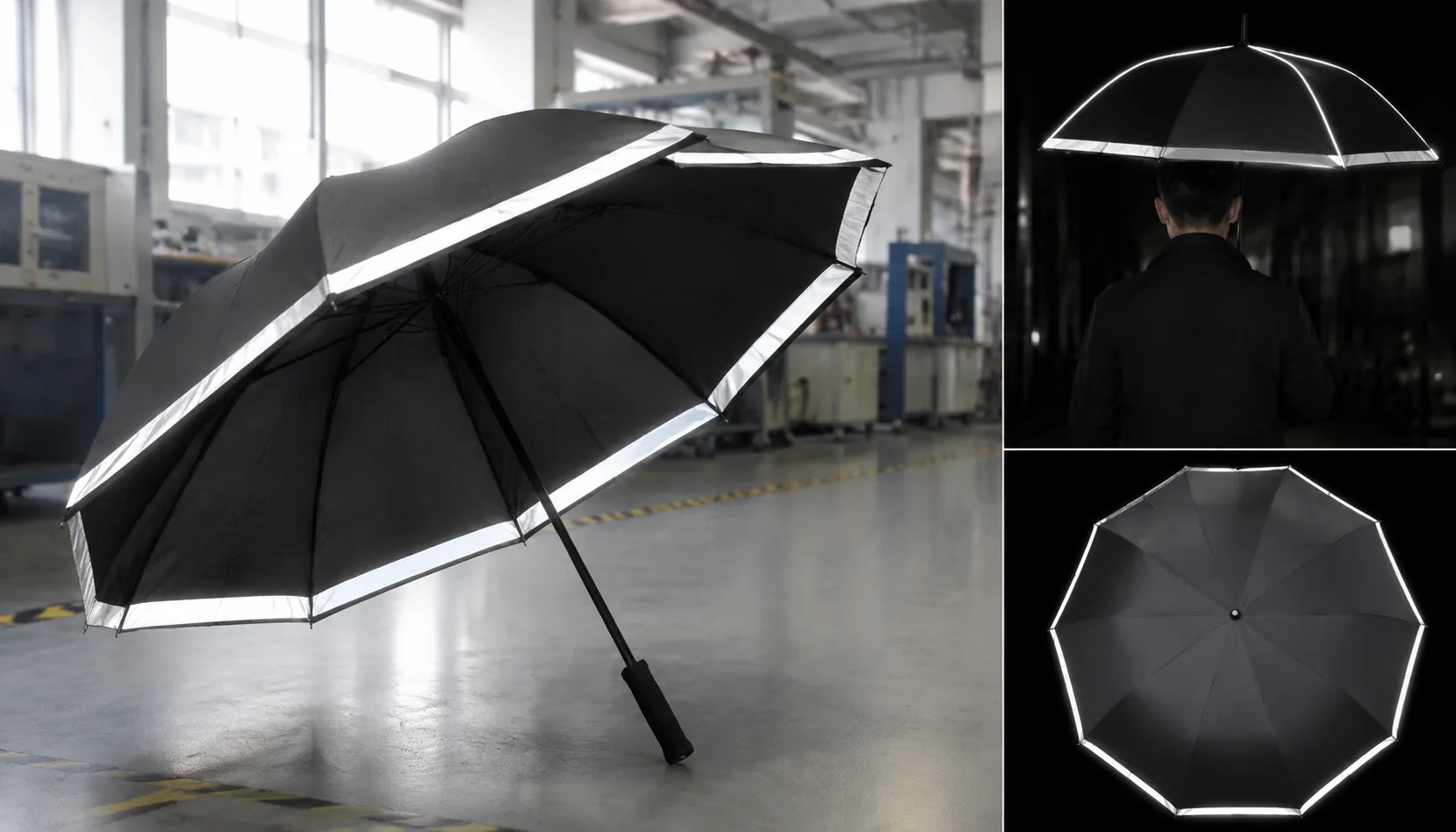
Reflective Safety Umbrellas: Specs for Night Visibility
Learn how to specify reflective safety umbrellas with visible trim, durable frames, compliant printing, MOQ planning, an...
Read More »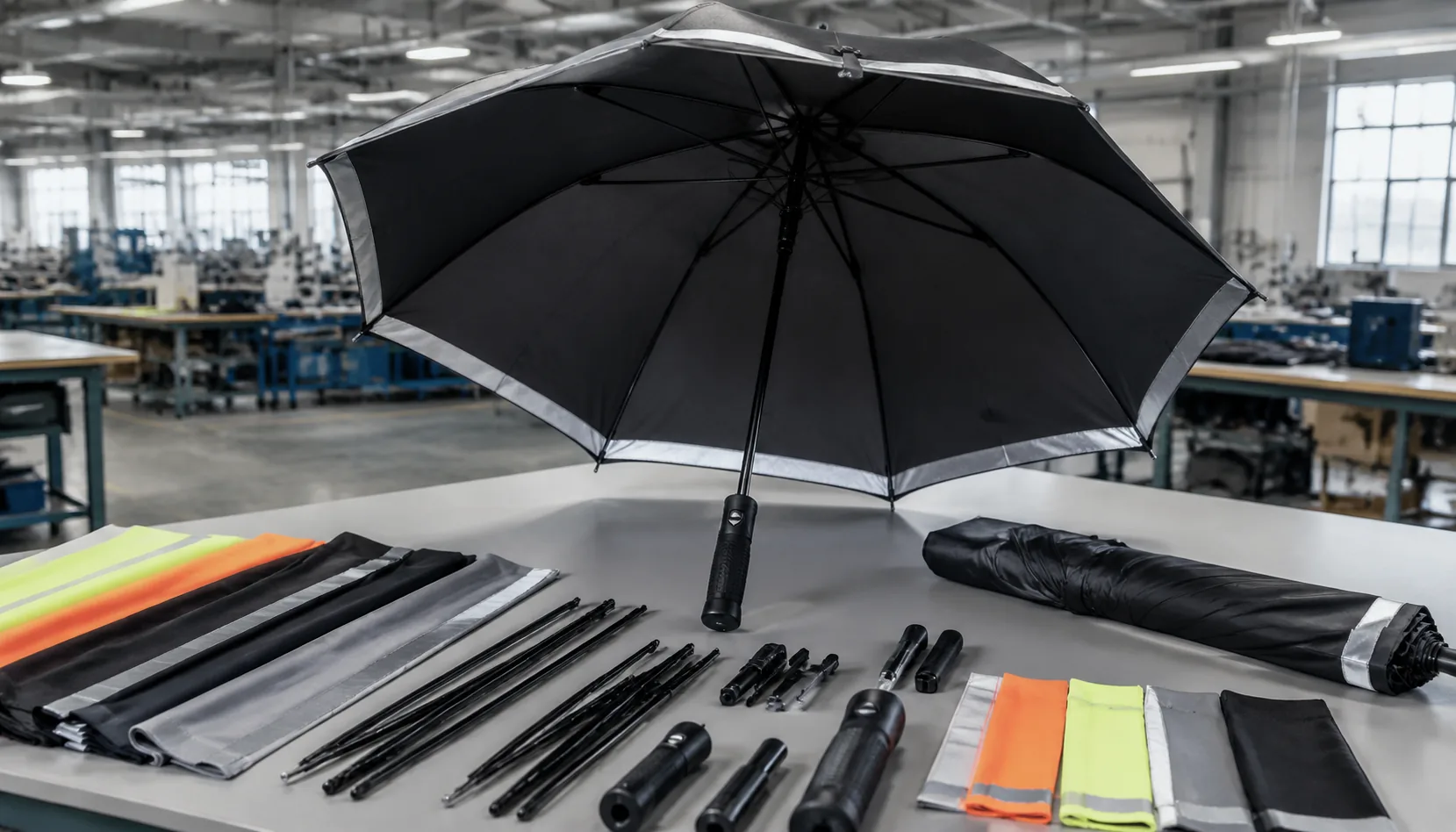
Reflective Safety Umbrellas: Buyer Spec Guide for Brands
Specify reflective safety umbrellas with proper tape, print zones, frame strength, and QC tests for commuter, school, an...
Read More »
Reflective Safety Umbrellas for Promo Buyer Spec Guide
Specify reflective safety umbrellas with 190T/210T pongee, fiberglass ribs, reflective piping, QC checks, MOQ, and shipp...
Read More »