Umbrella Frame Assembly Jigs: Rib Alignment for Bulk OEM
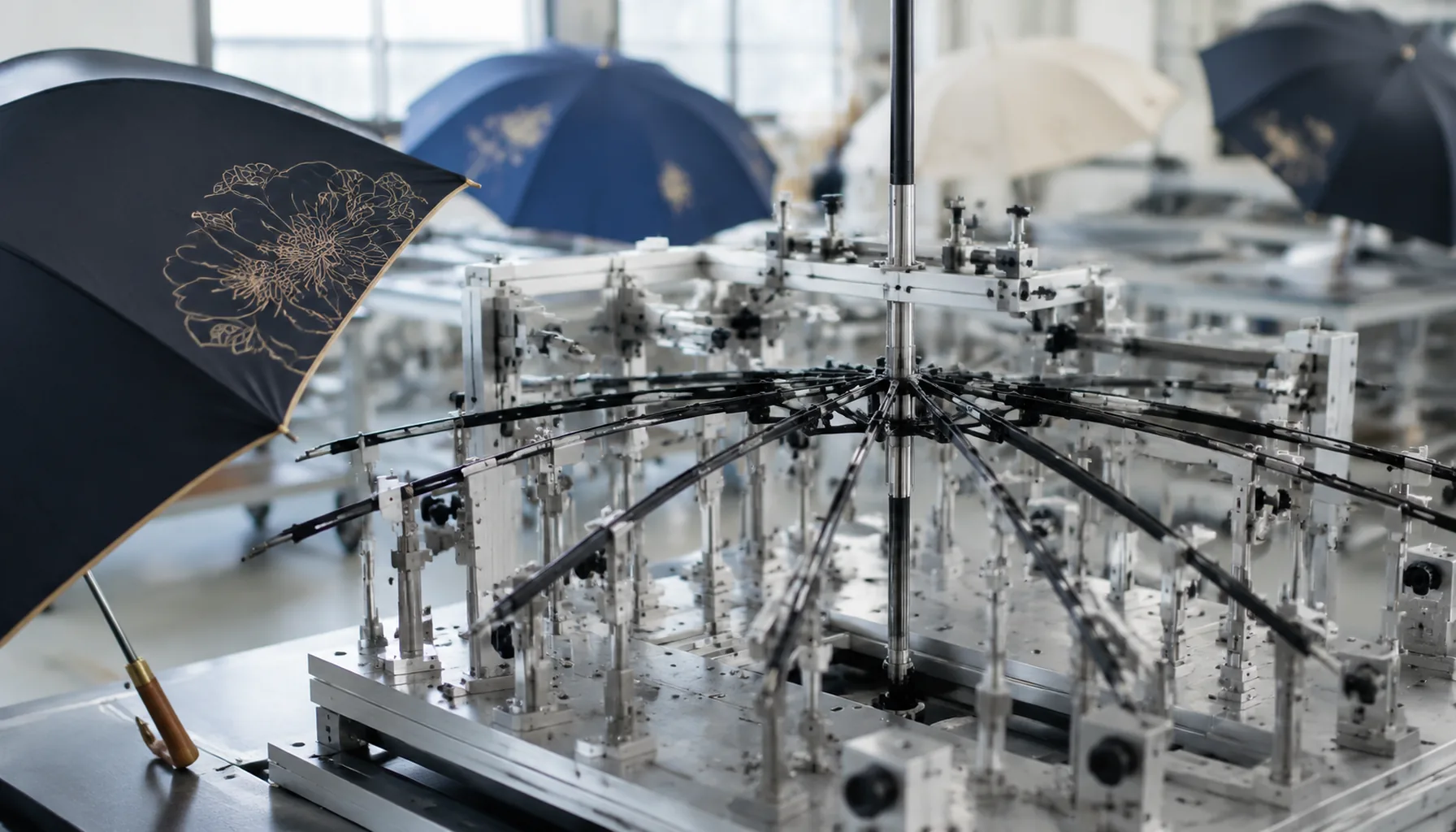
In bulk OEM umbrella production, small frame errors turn into visible wobble, uneven opening, and costly rework at inspection. The real challenge is holding rib angles, shaft straightness, and runner travel within tight limits across 8K and 16K builds, especially when batches shift between operators or tooling sets. Well-designed umbrella frame assembly jigs keep those variables locked down on the factory floor, where consistency is won or lost.
Why Rib Alignment Starts at the Assembly Jig
Umbrella frame assembly jigs are where rib geometry gets locked in, not at final inspection. The jig plate sets the rib spacing around the boss, the stretcher stop fixes effective length, and the crown locator establishes the open shape before the frame ever sees canopy cloth. For 8K and 16K umbrella frames, that matters because the same 2 or 3 mm error at the jig becomes a visible mismatch once the ribs spread under load. In OEM umbrella production, we use the jig to control symmetry first, then confirm it with go/no-go checks on rib angle, pivot height, and runner travel. If the crown is even slightly off-center, the frame may still open, but the geometry will be wrong for the pattern cut, which shows up later as panel overlap, seam pull, or loose corners.
The real problem with bad umbrella frame alignment is that the error compounds as the runner moves. A rib set that is angled too far in or out can create canopy twist, uneven tension across adjacent panels, and runner drag because the stretchers are no longer moving in a clean arc. On 16K frames, the tolerance stack is tighter because more ribs means more chances for mismatch to show up around the full circle; on 8K frames, the defect is easier to miss but still causes wobble and noisy opening. That is why umbrella quality control should start at the jig plate, not after sewing. If the open shape is controlled there, the finished umbrella closes smoother, holds tension more evenly, and stays consistent across bulk lots instead of drifting from unit to unit.
Steel, Fiberglass, and Hybrid Frames Need Different Controls
Steel ribs are forgiving in assembly but unforgiving after a bad bend. In OEM umbrella production, a 23" 8K steel frame will usually keep its geometry well during riveting, runner travel checks, and canopy fitting because the rib profile has memory in the formed channel. The problem is permanent deformation: if a worker over-presses a stretcher rivet, stacks frames too tightly, or forces a misaligned notch into the runner, the rib may look acceptable on the line but show one low panel after opening. Good umbrella frame assembly jigs for steel frames should control rib pitch, tip height, and stretcher angle, not just hold the shaft vertical. For bulk orders, I like go/no-go gauges at the rib tip circle and a 100% open-close check before canopy sewing, then AQL 2.5 final inspection for symmetry, runner lock, and loose rivets.
Fiberglass ribs fail differently. They flex through wind better, especially on double-canopy vented windproof umbrellas rated around 50+ mph, but they punish inconsistent drilling and punching. If the hole position on a fiberglass rib is off by even 1.0–1.5 mm, the rib can twist under load, the canopy seam will pull diagonally, and the umbrella frame alignment becomes unstable after repeated auto-open cycles. This matters more on 10K and 16K builds than basic 8K frames because each panel has less tolerance for rib length variation. Fiberglass jigs need hard location points for the rib end, center joint, and stretcher connection, plus controlled rivet pressure so the tube is not crushed. Our standard practice at ZheBrella is to check first-article frames against the canopy pattern before mass riveting, especially for 190T or 210T pongee canopies where seam tension makes small frame errors visible.
Hybrid frames need the tightest controls because steel and fiberglass do not move the same way. A steel shaft with fiberglass ribs is common for mid-range 21" compact auto-open-close umbrellas and 27" golf umbrellas where buyers want lower cost than full fiberglass but better wind recovery than full steel. The risk is mismatch: a rigid steel shaft and runner keep the center stable, while fiberglass ribs flex outward, so any off-center notch, uneven stretcher length, or loose runner spring creates panel imbalance. For these builds, umbrella frame assembly jigs should lock the shaft, runner, ribs, and stretchers together during the first rivet sequence, not after the frame is already partly assembled. In umbrella quality control, I want torque-free opening, equal rib-tip height, no runner wobble, and no rib crossing after 20 manual or auto-open cycles. That is where 8K 16K umbrella frames separate good tooling from lucky assembly.
Critical In-Line Checks Before Canopy Mounting
The last good moment to catch frame problems is before canopy mounting, because fabric hides bad metalwork and turns a cheap adjustment into a rework pile. On our line, umbrella frame assembly jigs are used first to confirm shaft straightness against a fixed V-block and dial reference; for 23" and 27" stick umbrellas we normally reject visible bend over 2 mm along the shaft, and folding models get checked at every telescopic joint for wobble. Runner travel distance is measured from the closed stop to full notch engagement, not guessed by hand feel. If the runner stops 3–5 mm short, the canopy will look tight in one panel and baggy in the next after sewing, especially on 190T or 210T pongee where tension shows clearly under light.
Notch seating and rib tip height are the two checks that separate clean OEM umbrella production from frames that only look acceptable in a carton. The notch must sit square on the shaft with no spin, cracked rivet, or loose wire crown; I tell inspectors to pull the first and opposite ribs at 180 degrees because that exposes uneven seating faster than looking from the top. Rib tip height is checked on a flat jig plate, with all tips landing in the same plane before ferrules or plastic tips are fitted. This matters more on 8K 16K umbrella frames: an 8K golf umbrella can tolerate a small rib variation visually, but a 16K frame multiplies every 1 mm height error into a wavy canopy edge. Good umbrella frame alignment also means ribs open symmetrically without one stretcher leading or lagging.
For auto-open and auto-open-close builds, the release test is done before fabric because a canopy adds drag and can mask a rough spring, burr, or weak latch until the buyer receives samples. Each unit should open cleanly with one press, no half-release, no metal scraping noise, and no runner bounce-back after the notch locks; compact 21" models are especially sensitive because short ribs put more load into the runner. We sample by line hour, not only by carton: inspectors pull frames every hour from each assembly table, record shaft, runner, notch, rib tip, and release results, then quarantine the hour’s output if the same defect repeats. For bulk orders, this in-line control is still backed by final AQL 2.5 inspection, where umbrella quality control includes opening cycles, visual symmetry, loose rivets, sharp edges, and packed quantity verification before FOB or DDP shipment release.
How Jig Accuracy Affects Windproof and Double-Canopy Builds
Double-canopy windproof umbrellas fail fast when rib height and vent spacing are not matched. If the top canopy sits 2 to 3 mm higher on one side, the vent opens unevenly, the inner layer starts fluttering, and the stitch line takes repeated shock load at the rib tips. In bulk OEM umbrella production, that kind of mismatch shows up most on 8K 16K umbrella frames, where the rib geometry is already tight and the extra moving layer has no room to self-correct. Good umbrella frame assembly jigs hold the stretcher pivot, rib crown, and top cap in one fixed reference so the frame comes off square, not just visually centered. That matters more on 23" and 27" vented builds than on simple single-canopy models because the airflow path is built into the geometry.
The main failure I see on the line is asymmetric vent opening: one vent lip lifts cleanly, the other stays trapped because the ribs were set with different preload or the stretchers were pinned at slightly different angles. Once that happens, panel strain concentrates near the seam crossing, and the canopy starts to wrinkle around the cap instead of venting air through the gap. Off-center top caps are another common problem; even a 1.5 mm shift pulls the ribs out of plane and creates a twist that no fabric cut can hide. For umbrella quality control, we check rib height, cap centering, and vent gap in the jig before sewing, because after the canopy is on, the error becomes expensive scrap rather than a quick frame correction.
On our production floor, the useful standard is simple: set the jig to the target size, lock the crown position, then verify each rib tip against the same datum before release. For 21" compact frames, the tolerance window can be a little wider, but for 30" storm builds the alignment has to stay tight enough that the two canopies share load evenly in gusts instead of fighting each other. That is why umbrella frame alignment is not a cosmetic issue; it is the difference between a vented umbrella that survives repeated opening cycles and one that rattles itself apart in a light wind. The best umbrella frame assembly jigs reduce rework, keep panel shapes consistent across cartons, and make inspection predictable instead of subjective.
Buyer Specs to Include in an OEM Tech Pack
Lock the frame specification before artwork, because a good canopy cannot rescue a bad skeleton. In an OEM tech pack, I want to see frame type first: straight stick, 2-fold, 3-fold, golf, reverse, or kids’ safety frame, then opening system: manual, auto-open, or auto-open-close. Rib count must be written clearly as 8K, 10K, 12K, or 16K, not just “windproof frame.” For 8K 16K umbrella frames, the rib geometry changes the jig setting, runner load, and sewing tension at the rib tips. Material must be split by part: steel shaft, aluminum shaft, fiberglass ribs, steel stretchers, zinc-plated runner, plastic or metal notch. If the buyer wants fiberglass main ribs with steel stretchers, say it directly. umbrella frame assembly jigs are set around these choices, so vague wording creates rework before bulk cutting even starts.
Runner travel tolerance is the spec many buyers forget, and it is one of the fastest ways to catch poor umbrella frame alignment. For a 23-inch straight umbrella, our standard practice at ZheBrella is to define closed runner position, open lock position, and allowable travel variation, often within ±1.5 mm after assembly depending on frame style. The tech pack should also state the required opening force, lock engagement, and whether the umbrella must survive cycle testing such as 500, 1,000, or 1,500 open-close cycles. For windproof models, include the target: for example, double-canopy vented construction, fiberglass ribs, and wind-tunnel survival above 50 mph. These numbers give the frame workshop a real benchmark instead of relying on a sample photo that may hide weak rivets, loose stretchers, or uneven rib arc.
Confirm MOQ assumptions and inspection evidence before PP sample approval, not after the deposit. A tech pack should state whether the MOQ is 500, 1,000, or 3,000 pieces per color, because frame procurement changes when we buy custom shafts, colored ribs, special runners, or 16K tooling parts. For umbrella quality control, ask for inspection photos showing rib-tip alignment, runner height in open and closed positions, rivet setting, notch engagement, frame arc from top view, and one opened sample beside a ruler or jig reference. For OEM umbrella production, I also recommend calling out AQL 2.5 for major defects and defining critical failures such as broken ribs, failed lock, sharp burrs, and canopy-frame mismatch. When these details are approved with the PP sample, bulk production can move straight into cutting, printing, sewing, and final assembly without losing 5–10 days to frame correction.
Frequently Asked Questions
Should buyers request separate frame jig checks for 8K and 16K umbrellas?
Yes. 16K frames have smaller rib spacing and more assembly points, so a jig that passes for 8K may still create uneven tension on 16K models.
Can frame alignment problems be fixed during final inspection?
Usually not cost-effectively. AQL 2.5 inspection can catch wobble, skew, or runner drag, but the root cause must be corrected at jig setup and in-line assembly.
What frame measurements should buyers confirm before approving 8K or 16K umbrella samples?
Buyers should confirm rib angle consistency, shaft straightness, runner travel distance, open-diameter tolerance, and tip-to-tip symmetry. For bulk OEM orders, these values should be recorded on a pre-production sample sheet before mass assembly begins.
How do assembly jigs reduce wobble in bulk umbrella production?
Jigs hold the shaft, runner, stretchers, and ribs in fixed positions during assembly so each rib opens at the same angle. This reduces uneven canopy tension, off-center tips, and runner friction that often cause wobble during open-close testing.
Can frame jig settings be adjusted for different umbrella sizes and rib counts?
Yes. A factory typically uses adjustable fixtures or separate jig plates for common sizes such as 21 inch, 23 inch, 27 inch, and golf umbrellas, with different settings for 8K, 10K, 12K, and 16K frames. Buyers should specify frame size, rib material, and automatic or manual opening type before tooling confirmation.
Looking to Launch Your Custom Umbrella Line?
ZheBrella is a Zhejiang-based OEM/ODM umbrella manufacturer with 17 years of export experience. Free design, low MOQ from 100 pieces, windproof construction, full-color print.
Get Free Quote Now »People Also Search For
Related Articles
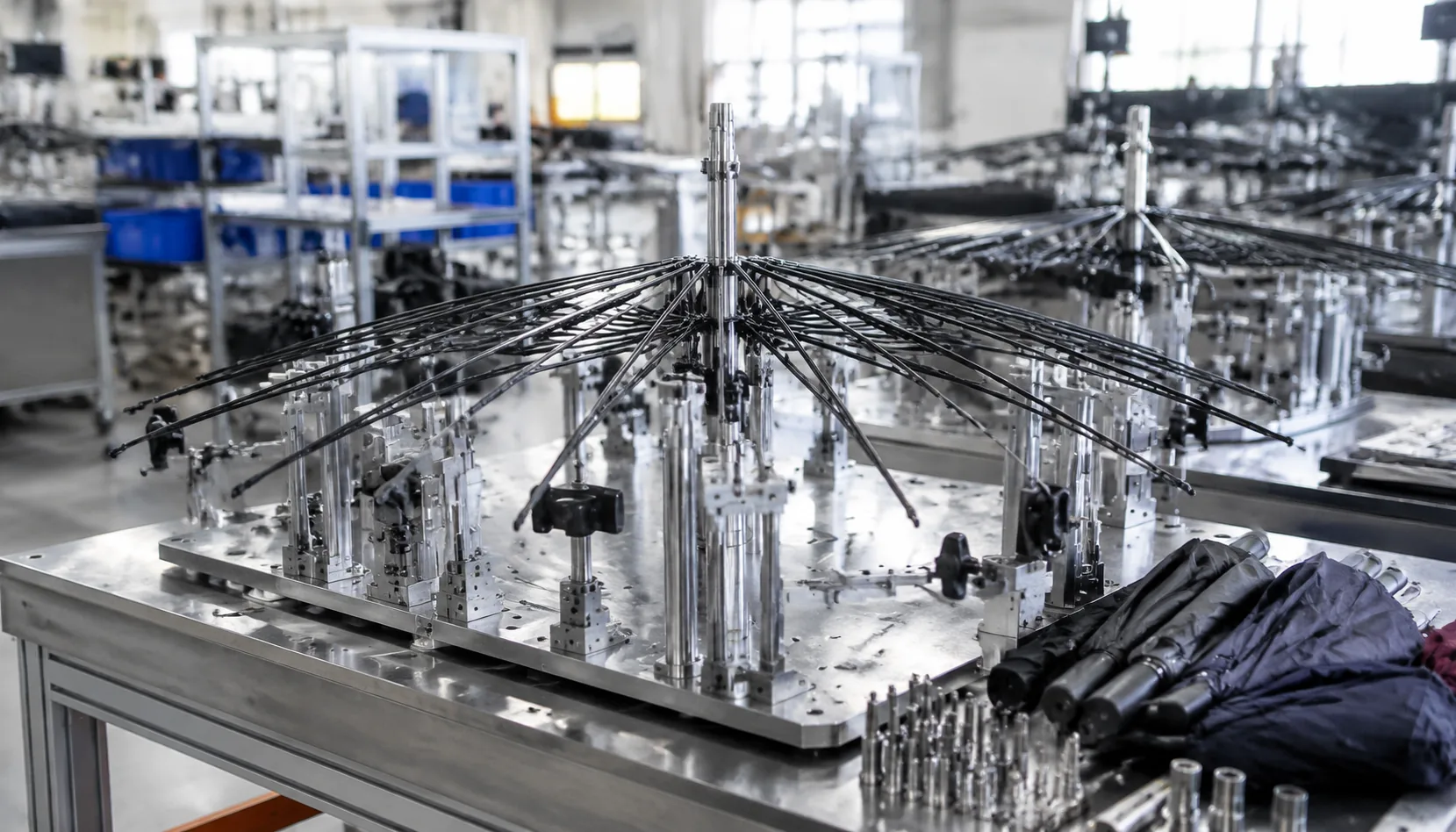
Umbrella Frame Assembly Jigs for Rib Alignment Control
See how assembly jigs control rib spacing, shaft straightness, and canopy symmetry to reduce defects in 8K, 10K, and 16K...
Read More »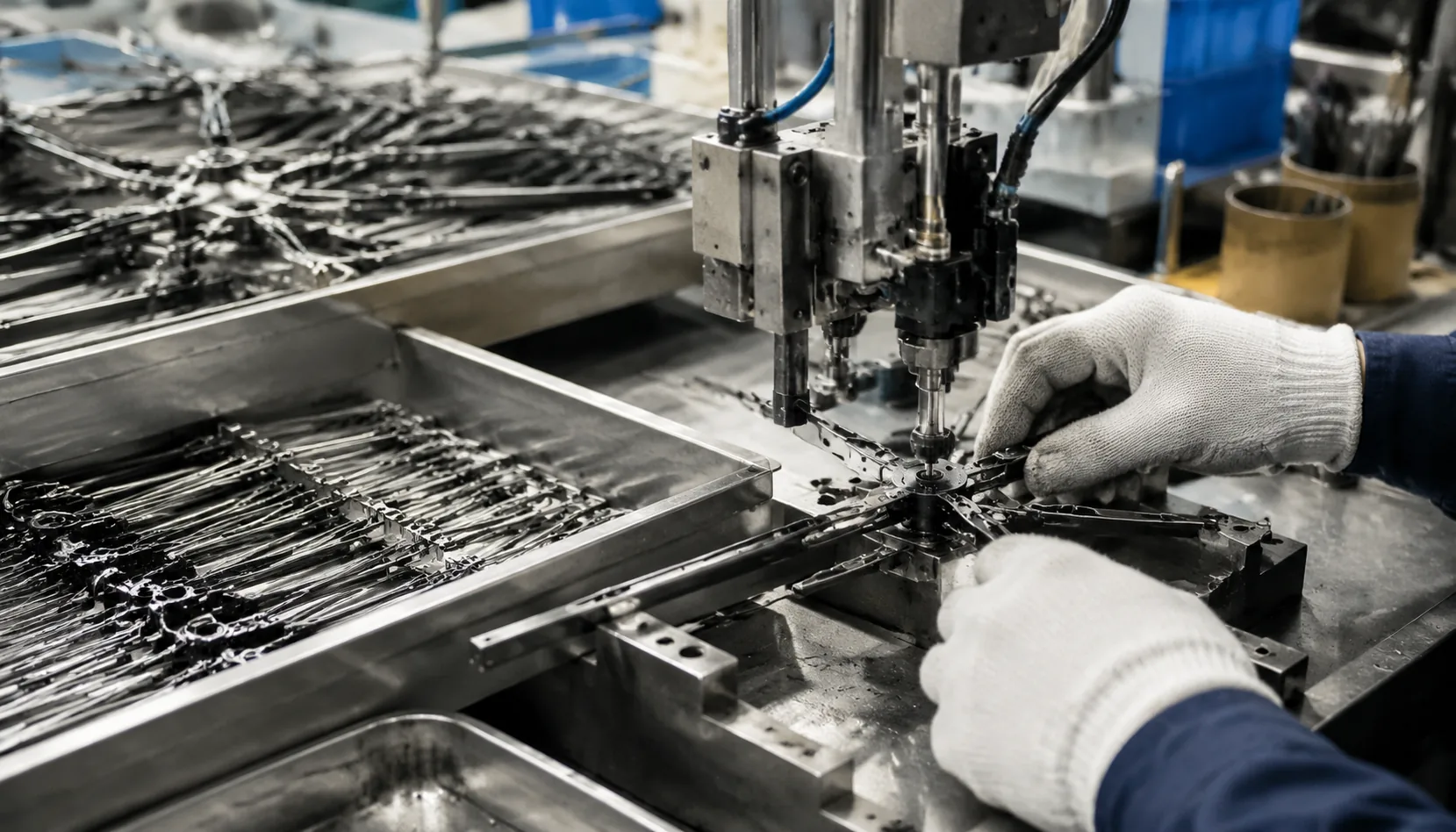
Umbrella Frame Riveting Process Control for Bulk Orders
See how rivet size, hole alignment, and pull-force checks improve umbrella frame durability across fiberglass, steel, 8K...
Read More »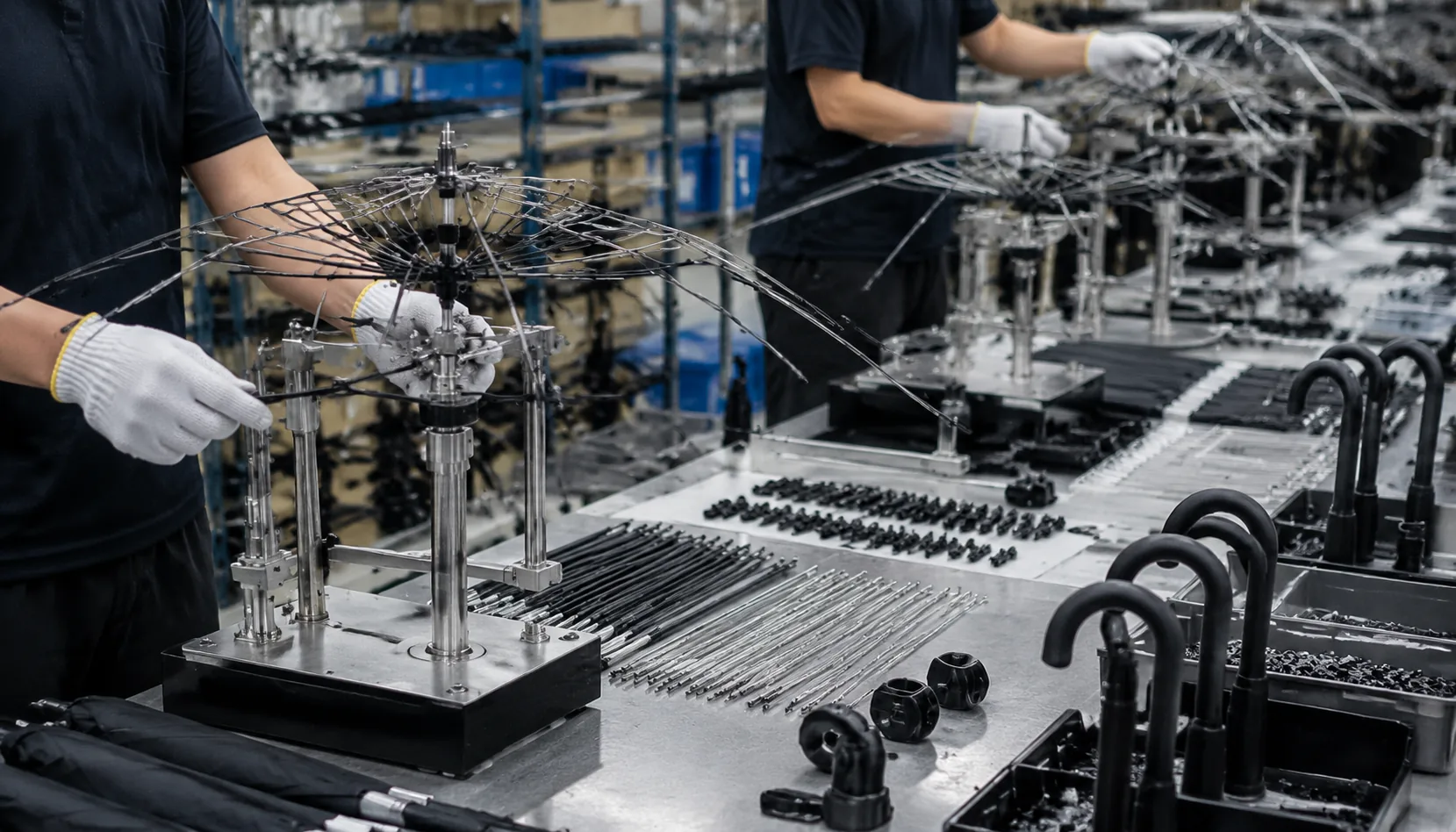
Umbrella Frame Assembly Jigs for Consistent Rib Alignment
Learn how frame assembly jigs control rib alignment, canopy tension, and opening smoothness in OEM umbrella production b...
Read More »