Umbrella Frame Riveting Specs for Stronger OEM Builds
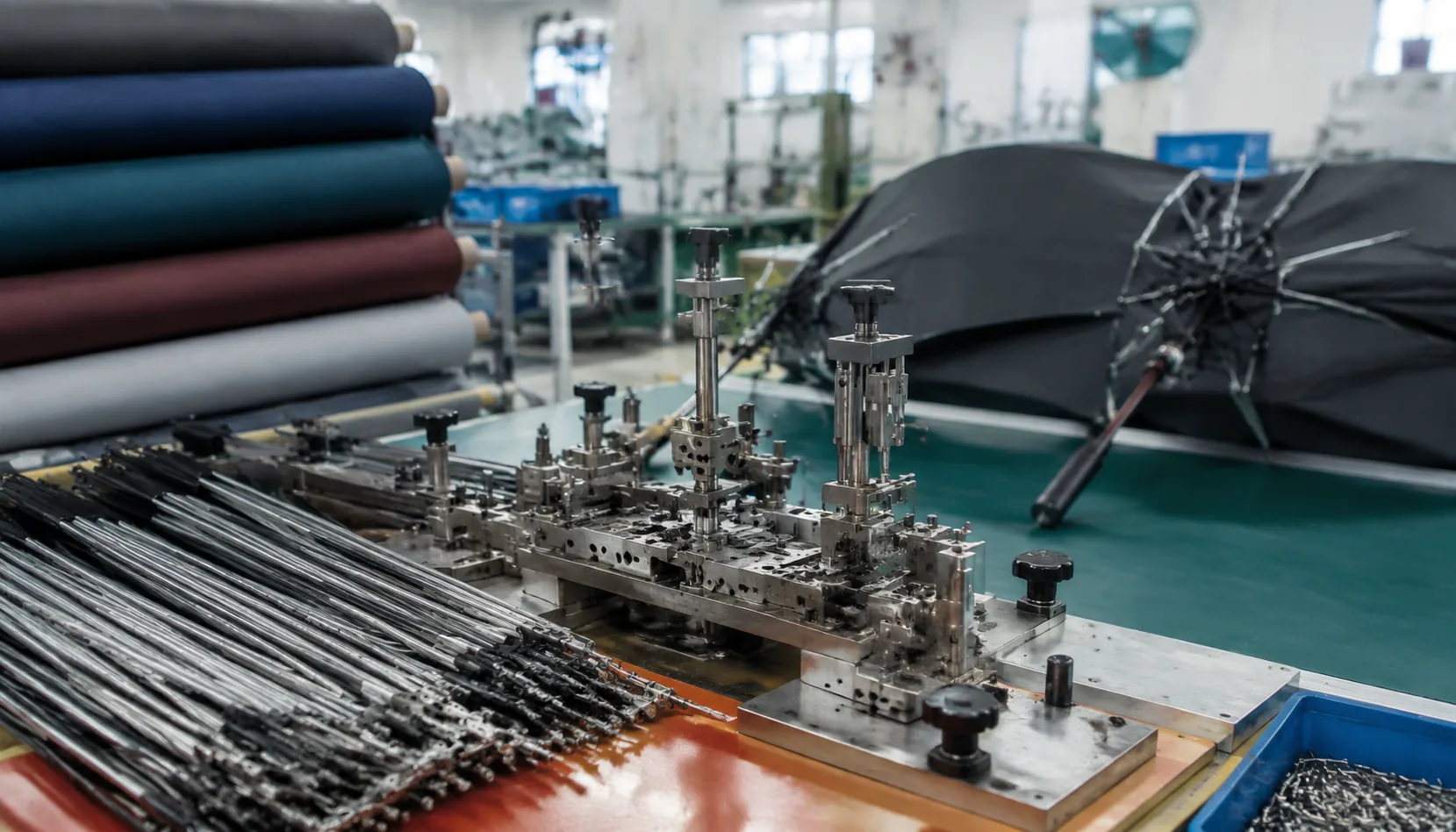
When an OEM umbrella fails at the rib joint, the problem usually started long before final inspection: soft rivets, oversized holes, weak pull force, or skipped cycle testing. On our Songxia production floor, umbrella frame riveting specs are set before bulk assembly so each frame has the right rivet material, controlled clearance, verified pull strength, and opening-close durability to match the buyer’s price point and warranty risk.
Why Riveting Determines Frame Durability
Rivets are the hinge system of an umbrella frame, not just small pieces of hardware. They connect the rib to the stretcher, the stretcher to the runner, the rib tip section to the intermediate joint, and the top rib set to the notch near the shaft. In umbrella rib assembly, every one of these points has to rotate smoothly while still holding alignment under canopy tension. A loose rivet gives the frame side play; the umbrella opens with a wobble, the canopy pulls unevenly, and the user feels a soft, unstable snap at full extension. An over-tight rivet is just as bad because it pinches the joint, slows the runner, and forces the spring or auto-open mechanism to fight friction instead of lifting the canopy. Good umbrella frame riveting specs define shank diameter, head size, clinch height, washer use, and joint clearance, usually checked with go/no-go gauges and opening-cycle tests before bulk assembly continues.
The stress map changes by umbrella type. A 21 inch compact umbrella has short folding ribs, multiple hinge points, and a telescopic shaft, so the highest risk is rivet shear at the middle joint when the frame is reversed by wind or squeezed in a bag. For compact auto-open-close models, we pay extra attention to runner-side rivets because the closing spring pulls hard through the stretcher set. A 23 inch stick umbrella has fewer joints, but each rib is longer, so poor rivet alignment near the notch makes the canopy twist and can crack plastic tips or bend steel stretchers. A 27 or 30 inch golf umbrella spreads load across 8K, 10K, or 16K ribs, but the leverage is much higher; one bad rivet can let a long rib oscillate until the canopy seam tears or the joint head walks out.
Material choice changes the riveting method. Fiberglass rib riveting needs a controlled clinch because fiberglass does not tolerate crushing; if the rivet head bites too deep, the rib may look fine at inspection but split after 200 to 500 open-close cycles. A steel rib umbrella frame is more forgiving on compression, but burrs around punched holes can cut plating and start rust, especially on beach or event umbrellas exposed to salt air. In OEM umbrella frame manufacturing, our standard practice at ZheBrella is to match rivet hardness to rib material, deburr punched holes, and sample-test joint rotation before canopy sewing hides the frame behavior. Strong builds are not made by using the thickest rivet possible; they come from repeatable umbrella frame riveting specs that leave enough clearance for movement, enough clinch to prevent wobble, and enough consistency to pass AQL 2.5 inspection without rework.
Choosing Rivets for Fiberglass and Steel Ribs
Rivet choice should start with the rib material, not the buyer’s target price. For most 8K and 10K promotional umbrellas, nickel-plated steel rivets are the workhorse: good shear strength, fast feeding on semi-automatic riveting machines, and lower cost than stainless. The weakness is corrosion if plating is thin or damaged during setting, especially on beach umbrellas, golf umbrellas, or DDP orders headed to humid coastal markets. Stainless steel rivets cost more, but I prefer them for 27" and 30" frames, double-canopy vented windproof builds, and any steel rib umbrella frame expected to survive repeated wet storage. Brass rivets are easy to set and resist rust, but they are softer; they suit light manual-open 21" or 23" models better than high-tension auto-open frames. Good umbrella frame riveting specs should define rivet material, head diameter, shank diameter, grip range, plating thickness, and salt-spray expectation, not just say “standard rivet.”
Fiberglass rib riveting needs more control than steel because the rib does not deform like stamped metal; it cracks, splinters, or delaminates if the hole is punched aggressively. In OEM umbrella frame manufacturing, we drill fiberglass ribs with controlled feed and sharp bits, then reject holes with whitening, ovaling, or exposed fibers around the edge. A small washer or eyelet support under the rivet head spreads load across the rib wall, especially at the stretcher joint where torque is highest during inversion. For 16K frames, washer consistency matters because every extra friction point affects opening force and canopy tension. Our standard practice at ZheBrella is to check fiberglass rib riveting after frame cycling, not only after the first assembly pass, because hairline splits often appear after 20–30 open-close cycles. If a supplier skips washer support to save fractions of a cent, the failure usually shows up as loose ribs before AQL 2.5 inspection even starts.
Steel ribs tolerate higher riveting pressure, but they still need proper clearance and burr control. On a steel rib umbrella frame, the hole edge should be clean after punching, because burrs cut plating and start rust from the inside of the joint. Nickel-plated steel rivets with steel ribs give a strong, economical joint for 190T pongee rain umbrellas, but I would upgrade to stainless rivets when the canopy uses PVC, POE, or EVA panels because transparent umbrellas trap moisture and show rust stains quickly. Brass can be useful where smooth rotation is more important than peak strength, such as light decorative frames, but it should not be the default for windproof builds rated 50+ mph. Practical umbrella frame riveting specs should also call out pull-out testing, rotational looseness limits, and sample cycling before mass production. A good target is a rivet that rotates freely without side play, holds alignment after canopy sewing tension, and does not deform the rib profile during setting.
Hole Diameter, Clearance, and Joint Movement
Correct hole clearance matters more than raw rivet size. For a common 23" manual 8K frame, we usually see stretcher and rib wall thickness in the 0.45–0.70 mm range on steel parts, and 1.2–1.8 mm molded ends on fiberglass ribs. A 2.4 mm semi-tubular rivet normally wants a punched hole around 2.45–2.55 mm, not 2.8 mm, because excess clearance makes the joint oval after 500–1,000 open-close cycles. For heavier 27" or 30" golf frames, 2.8–3.2 mm rivets are common at crown, runner, and main rib joints, with hole clearance kept around +0.05 to +0.15 mm depending on plating thickness. These umbrella frame riveting specs should be locked before mass production, because changing rib gauge after tooling approval changes joint stack height, cap roll, and opening feel.
Burr control is where many low-cost frames fail. In umbrella rib assembly, punched steel stretchers must have the burr side controlled and deburred before riveting; a sharp burr facing into a plastic runner lug or fiberglass end fitting will shave material and create a loose joint after shipment vibration. For a steel rib umbrella frame, zinc or black electrophoresis coating adds roughly 8–20 microns per side, so the hole gauge should be checked after finishing, not only after stamping. For fiberglass rib riveting, the molded insert or drilled eye must not be crushed by an over-rolled rivet head; the rivet should flare cleanly while leaving visible rotation clearance. Our standard practice at ZheBrella is to inspect joint movement by hand before canopy sewing, because a tight frame hidden under 190T pongee becomes much harder to correct later.
Free-moving does not mean sloppy. A good joint rotates smoothly with light thumb pressure, has no side-to-side rattle, and does not bind when the runner reaches the top notch on manual, auto-open, or auto-open-close mechanisms. In OEM umbrella frame manufacturing, I like to separate inspection by frame type: 8K frames have fewer joints, so one tight stretcher can twist the whole canopy; 16K frames have twice the joint count, so the bigger risk is accumulated torque variation and uneven rib spacing. On 16K windproof builds with fiberglass ribs and double-canopy venting, we check every crown and runner joint for consistent torque feel before AQL 2.5 final inspection. Practical umbrella frame riveting specs should define rivet diameter, hole diameter, head height, rolled flare diameter, and acceptable rotation feel, not just list a part number on the BOM.
Production Checks During Frame Assembly
The most useful production checks happen at the riveting table, not at final inspection, because a bad rivet changes rib geometry before the canopy ever touches the frame. For umbrella frame riveting specs, I want the writer to describe go/no-go gauges for rivet head diameter, exposed shank, and joint clearance after setting. In our shop, a typical 8K or 10K steel rib umbrella frame uses tighter hinge clearance than a fiberglass rib design because steel ribs deform less under press load, while fiberglass rib riveting needs more care to avoid crushing the rib eyelet. Operators should check every station at shift start, then sample every 30–50 frames after tool adjustment. A simple feeler gauge catches loose joints, but a dedicated go/no-go pin is faster when the line is pushing 1,500–3,000 frames per day. If the gauge fails, production should stop long enough to check rivet length, die wear, and pneumatic press pressure instead of sorting defects downstream.
Visual burr checks should be treated as a safety and durability requirement, not cosmetic polishing. In umbrella rib assembly, burrs around stretchers, rib tips, and runner links can cut 190T or 210T pongee during cycling, especially on compact 21 inch auto-open-close frames where the canopy folds tightly against the hardware. The writer should specify that inspectors look for split rivet heads, off-center clinching, cracked plating, sharp edges, and ovalized holes after riveting. Manual opening smoothness is another fast screen: the frame should open without a gritty feel, twisting ribs, or a runner that stalls halfway up the shaft. For 23 inch and 27 inch manual or auto-open builds, I usually expect one clean stroke to full lock with no rib crossing and no asymmetric canopy pitch when the bare frame is held vertically. These checks matter in OEM umbrella frame manufacturing because small hinge drag becomes a warranty issue after printing, sewing, packing, and export freight are already paid.
Random pull tests give the numbers behind the operator’s hand feel. The section should recommend sampling finished bare frames by lot, then applying controlled pull force at rib-to-stretcher joints, runner links, and tip assemblies to confirm the rivet does not rotate excessively, pull through, or crack the rib eyelet. For promotional umbrellas, a practical line check may be lower than lab destruction testing, but it should still be recorded against the buyer’s umbrella frame riveting specs and tied to AQL 2.5 inspection results. Auto-open frames need extra checks because the spring hides problems until the user presses the button. The runner lock must engage fully, the button should release without sticking, and spring force should open the frame decisively without slamming hard enough to bend 8K steel ribs or overstress fiberglass ribs. On auto-open-close models, check both opening and collapsing cycles at least 5–10 times per sampled unit, because weak runner engagement often appears only after repeated cycling.
Testing Riveted Frames Before Shipment
The fastest way to find weak riveting is not a pull test; it is repeated opening and closing under load. For promotional orders, most buyers specify 300–500 manual or auto-open cycles on 23" and 27" frames, while retail brands often ask for 800–1,500 cycles, especially on auto-open-close folding umbrellas where the runner impact is harsher. In our umbrella rib assembly line, we check whether the rivet head stays seated, whether the washer bites into the rib properly, and whether the stretcher joint develops side play after cycling. A good rivet should rotate smoothly without cutting into a fiberglass rib or elongating the hole on a steel rib umbrella frame. These umbrella frame riveting specs need to be written before mass production, because a 0.1 mm change in rivet shank diameter can make the joint either too tight to move or loose enough to rattle after two cartons of handling.
Wind simulation catches problems that normal cycle testing misses, especially on 8K and 10K frames with mixed fiberglass and steel components. For basic promotional umbrellas, we usually test at 30–35 mph with three inversion recoveries; for stronger retail builds, buyers may request 45–50+ mph on double-canopy vented windproof frames. During testing, we watch the riveted points at the tip cup, stretcher, and runner connection because failure often starts as twisting, not a clean break. Fiberglass rib riveting needs a wider bearing surface than steel because the material can crush if the rivet is over-set; steel ribs tolerate more pressure but rust quickly if the plated layer is damaged during riveting. In OEM umbrella frame manufacturing, the frame should be tested with the actual canopy fabric, whether 190T pongee, 210T pongee, POE, PVC, or EVA, because canopy tension changes the load path through every riveted joint.
Corrosion checking is not optional for plated steel parts, even when the umbrella looks fine at final assembly. Nickel-plated, zinc-plated, and black-coated steel ribs should be checked after humidity exposure or salt-spray testing, commonly 24–48 hours for promotional orders and 72 hours or more for retail programs. The risky areas are cut ends, punched holes, and rivet seats, where plating can crack during forming. For bulk inspection, our standard practice at ZheBrella is AQL 2.5 for major defects, with rivet looseness, missing washers, cracked rib holes, poor runner alignment, and red rust treated as rejectable issues. Inspectors should sample finished umbrellas by carton, not just loose frames, because transport vibration can reveal weak joints. Clear umbrella frame riveting specs should define cycle targets, wind rating, corrosion standard, and inspection method on the PO, so the factory is not guessing after production has already started.
Frequently Asked Questions
Are stainless steel rivets always better for umbrella frames?
Not always. Stainless steel improves corrosion resistance but costs more and may be harder to set; nickel-plated steel can be adequate for standard city umbrellas if plating and salt-spray requirements are clear.
What rivet defects should import inspectors reject?
Reject sharp burrs, cracked fiberglass at holes, loose joints, frozen joints, missing washers where specified, and any rivet that affects smooth manual or auto-open operation.
What rivet materials are commonly specified for OEM umbrella frames?
Most OEM builds use nickel-plated steel, stainless steel, or brass rivets depending on corrosion resistance and target price. For coastal or premium retail programs, stainless steel rivets are usually preferred because they reduce rust claims during storage and wet use.
What hole clearance should buyers specify for umbrella rib riveting?
A practical hole clearance is typically 0.1–0.2 mm over the rivet shaft diameter, depending on rib material and plating thickness. Too little clearance can crack fiberglass ribs, while too much clearance creates loose joints and frame wobble.
How many open-close cycles should an OEM umbrella frame pass before bulk assembly?
For standard retail umbrellas, buyers often require 500–1,000 open-close cycles before approval. Windproof or premium models may be tested to 1,500–3,000 cycles, combined with rib joint pull tests and visual checks for loose rivets.
Looking to Launch Your Custom Umbrella Line?
ZheBrella is a Zhejiang-based OEM/ODM umbrella manufacturer with 17 years of export experience. Free design, low MOQ from 100 pieces, windproof construction, full-color print.
Get Free Quote Now »People Also Search For
Related Articles
Umbrella Rib Riveting Process for Stronger OEM Frames
See how rib riveting, hole alignment, and pull-force checks improve frame strength and consistency in OEM umbrella manuf...
Read More »
Umbrella Frame Riveting Specs for Consistent Bulk Assembly
Learn how rivet diameter, washer choice, rib alignment, and in-line pull tests reduce 8K/16K frame failures before AQL 2...
Read More »
Umbrella Frame Riveting Process Controls for Bulk Orders
Set rivet, washer, and joint specs that reduce loose ribs, warped frames, and opening failures across steel and fibergla...
Read More »