Logo Size and Repeat Strategy for Branded Umbrella Orders
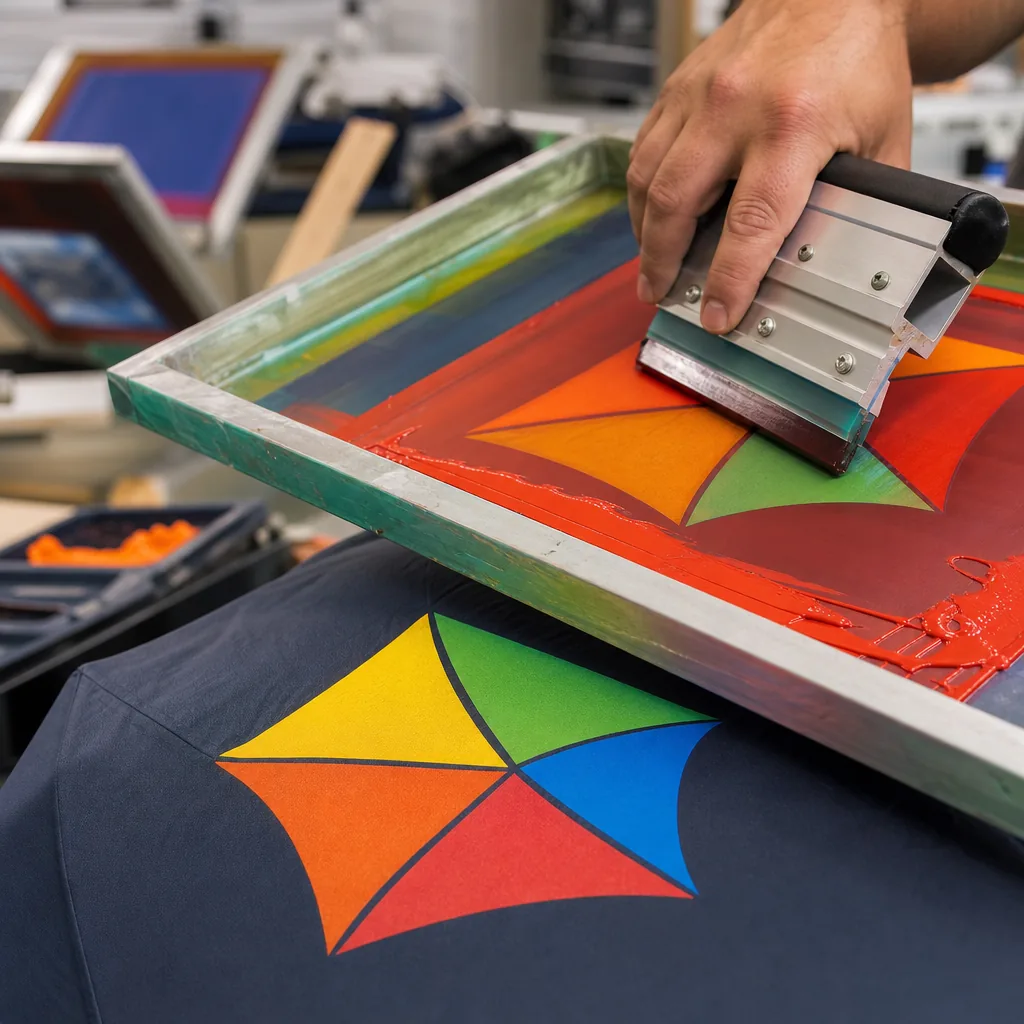
When buyers approve branded umbrellas, the same logo can look crisp on a mockup and awkward on a curved canopy, so scale and repeat have to be judged against the panel layout, print method, and viewing distance. This umbrella logo size guide reflects what we check on the factory floor at ZheBrella: how many panels can carry artwork cleanly, where a mark starts to distort, and when a bigger repeat drives up sampling time, ink use, and rejection risk.
Why Logo Scale Changes by Umbrella Style
Compact 21" folding umbrellas have the tightest print constraints. Short tapered panels, hinge hardware, and the top third of the canopy usually leave only 9 to 12 cm of usable width near the center seam and about 14 to 18 cm at the lower edge. That means minimum logo size should be set from the flat print zone, not the sewn panel outline. Rib count changes the math: an 8K frame gives broader panels and more readable canopy panel branding, while a 16K frame breaks the dome into narrower slices and reduces available width fast. On 16K compacts, a logo repeat pattern often works better than one oversized mark because the artwork can follow the panel geometry without crossing too many seams.
Golf umbrellas give you the most room, especially in 27" and 30" sizes. Usable panel width commonly reaches 22 to 30 cm, which supports larger promotional umbrella artwork and clearer logo placement. An 8K golf frame usually leaves enough center-panel space for a single logo with normal margins; a 16K layout narrows each panel, so the same artwork often needs to shrink or repeat across panels. Double-canopy windproof styles also change the visible branding zone: the outer canopy is the main surface, but the vent gap can interrupt a logo repeat pattern if the print runs too close to the crown. Auto-open and auto-open-close frames add another risk point because the runner, strap, and top hardware can cover part of the print when folded or only partially opened.
Stick umbrellas are the most predictable option for branding, especially in 23" and 27" sizes. Their panels stay fuller than compact frames, so the printable zone is easier to control on both 8K and 16K layouts. For screen print or heat-transfer work, keep key text inside a safe rectangle with at least 10 to 15 mm clearance from seams and ribs to reduce edge distortion and ink cracking. On pongee 190T or 210T canopies, a repeated logo across alternating panels often reads better than one large block, particularly when the customer wants retail shelf impact or corporate gifting consistency. The practical rule in any umbrella logo size guide is simple: as the frame gets smaller, more segmented, or double-canopy, design for repetition and visibility instead of maximum size.
Set Minimum and Maximum Logo Sizes by Print Method
A practical umbrella logo size guide starts with fabric and print method, not the artwork file. On 190T pongee, screen print is the most sensitive to fine detail: keep small text at roughly 6–7 pt and line weight at 0.8–1.0 mm minimum, or letters, reversed spaces, and thin serifs will start to fill in on curved canopy panel branding. Digital print gives better tonal range for promotional umbrella artwork, but hairlines below about 0.5 mm still break at the panel apex where the canopy bends. Transfer applications can hold sharper edges than a weak screen print, but the film adds thickness, so thin fonts and tight kerning need extra clearance. For 210T pongee, the tighter weave supports cleaner dot gain control and better white-ink hold, so the minimum logo size can usually be reduced a step without losing legibility. Use 210T when the art includes small text, fine rules, or two-color registration; on 190T, simplify the mark before you shrink it.
Dark canopies change the risk profile because white ink has to create the contrast. If the underbase is too weak, red, yellow, and light gray lose legibility quickly, and black-on-color art can disappear in indoor or overcast light. On dark polyester, increase stroke weight first, then scale the artwork up about 15–20 percent before changing the print method. As a rule, keep small copy bold enough to survive one-step registration drift and panel stretch. For a standard 23" or 27" umbrella, a single panel usually supports about 120–160 mm of logo width before the mark starts wrapping toward the seam; a 30" golf umbrella gives more room, while 21" compact frames need tighter margins and simpler copy. If the buyer needs broader visibility, a logo repeat pattern across alternating panels is often cleaner than forcing one oversized mark onto a curved surface, because it reduces distortion and gives the factory a clearer target for repeat pattern alignment and approval.
Choose Single-Panel, Alternating, or Full-Repeat Layouts
Single-panel branding is the safest choice when the logo is small, the budget is tight, or the order is for corporate gifts where legibility matters more than coverage. On 23" and 27" umbrellas, the minimum logo size should be set by the usable panel width after seam allowance, not by the flat mockup; that usually means a one-screen or one-transfer setup with one registration target and fewer chances for drift. For solid 190T or 210T pongee canopies, a single hero panel also prints cleaner than stretching promotional umbrella artwork across seams. This layout keeps prepress simple, lowers setup cost, and usually supports the lowest MOQ because the factory only has to approve one placement and one color count.
Alternating-panel branding works better for event giveaways, sponsor umbrellas, and team merchandise when you want visibility from multiple angles without paying for a full-repeat layout. Printing every other panel improves canopy panel branding, but it adds screen count, registration checks, and inspection time, especially on auto-open frames where panel tension can shift at the edges. Each extra color adds cost in screen printing because it requires another screen, another setup pass, and more wash time; transfer and sublimation reduce some prepress work, but the logo repeat pattern still has to fit the panel geometry. Buyers should expect a higher MOQ than single-panel orders because the factory needs one locked artwork file and one production schedule across the run.
Full-repeat layouts are the most expensive option, but they make sense for retail umbrellas, licensed graphics, and high-visibility promotions where the canopy is the ad space. Printing every panel increases ink usage, setup time, and rejection risk, especially on 8K or 10K frames where more seams create more registration points. This is where the umbrella logo size guide matters most: artwork that looks balanced on a flat file can become cramped once it is split across narrow panels, so panel width should drive the layout decision. Compared with a single-panel order, a full-repeat usually needs the highest MOQ, the longest lead time, and stricter approval before production starts because color matching and seam alignment have to pass QC at every panel.
Build an Approval Process That Reduces Print Risk
The fastest way to reduce print risk is to lock the approval path before frames are cut or screens are set. A usable umbrella logo size guide starts with a scaled artwork proof, not a screenshot, and it should show each canopy panel at actual print size for the correct frame size — 21", 23", 27", or 30" — and the rib count, such as 8K, 10K, or 16K. Buyers should require the minimum logo size in writing so small text stays legible on a 190T or 210T pongee canopy. If the order uses a repeat pattern, the proof must show exact panel-by-panel placement for canopy panel branding, plus the full logo repeat pattern across seams. For promotional umbrella artwork with thin lines, gradients, or reversed type, insist on vector files and a Pantone target before production is booked.
Before bulk production, request a pre-production sample and treat it as a fit-and-print check, not a formality. Verify panel centering against the seam line, confirm seam clearance so no key element lands in the stitch path, and check closure strap alignment so the logo still reads correctly when the umbrella is tied shut. Color tolerance should be agreed in advance with a signed physical swatch or a written ΔE target, because ink on pongee 190T or 210T often shifts after cure. If the sample needs changes, plan on lead times of several extra days for artwork revision, new plates or screens, and re-approval before the order can move into bulk.
Build the inspection standard into the PO so the factory knows what will be rejected. Ask for AQL 2.5 inspection on print position, missing ink, seam damage, and shade consistency, with checks pulled from the start, middle, and end of the run. That matters on repeat orders because a logo repeat pattern that passes on one panel can drift when sewing tension changes across the lot. The practical rule is simple: if the proof, pre-production sample, and approval notes all match, production risk drops; if any one is vague, the cost shows up later in reprints, scrap, and delayed shipments. Use the umbrella logo size guide to close these points before mass production begins.
Match Branding Ambition to Budget and Incoterms
If you want a usable umbrella logo size guide, start with decoration cost, not aesthetics. A single-panel logo on a 23" or 27" umbrella is usually the lowest-cost option because it needs one screen or transfer plate, fewer color separations, and less alignment time. By contrast, a logo repeat pattern across two to eight canopy panels increases registration work on curved panels, which raises the chance of rejects and often triggers a strike-off before bulk approval. On 190T pongee or POE canopy, a 1-color mark typically stays in the base decoration tier; a 4-color canopy panel branding layout can move the order into a higher sampling charge and add 3–7 days to the pre-production cycle. The minimum logo size also matters: artwork that looks clean on a flat proof can fail once it is wrapped over seams or narrowed by rib curvature.
MOQ breakpoints usually follow the same logic. For stock umbrellas, 300–500 pieces is common for one-color print or simple transfer branding; once you request full-panel printing, multi-panel repeat artwork, or mixed placement across the canopy, many suppliers quote 1,000 pieces or more to cover setup, color matching, and QC. Larger repeated logos also change labor allocation: the print team must lock panel sequence, seam direction, and stitch order earlier, and any mismatch can create scrap. Sampling can move from 3–5 days for basic decoration to 7–14 days when the promotional umbrella artwork requires wraparound placement, vent cuts, or tight panel-to-panel alignment. Buyers should treat logo size, repeat count, and MOQ as one production decision, because changing any one of them can change print labor, approval timing, and the final unit price.
Freight and carton efficiency depend on Incoterms. Under FOB, the factory quote covers goods and export packing, so compact canopy panel branding that fits standard carton counts usually keeps ocean freight stable per unit. Under DDP, landed cost is more sensitive to chargeable volume because inland trucking, customs clearance, and final delivery all follow carton cube; if larger artwork forces bigger cartons or fewer umbrellas per master carton, the freight savings from simpler printing can disappear fast. A 10% increase in carton volume can erase much of the benefit of a cheaper decoration method once the shipment is priced on volumetric weight or pallet count. The practical rule is simple: compare FOB and DDP quotes using the same umbrella logo size guide assumptions for artwork size, logo repeat pattern, and carton packing, or the lowest print price may produce the highest landed cost.
Frequently Asked Questions
How small can a logo be on a promotional umbrella and still read clearly?
As a rule, small text and thin lines become risky below roughly 5-6 mm letter height, especially on 190T pongee and curved canopy panels. Buyers should request a physical sample if the logo includes fine serifs, outlines, or reversed white text.
Does printing the logo on every panel always improve brand visibility?
Not always. Repeating on every panel raises print cost and can look crowded on 16K umbrellas with narrow panels. Alternating panels often balances visibility, cleaner design, and better budget control.
How many canopy panels should carry the logo for the best balance of cost and visibility?
For most promotional orders, 2 to 4 printed panels gives strong brand visibility without pushing unit cost too high. Printing all 8 panels improves exposure but usually adds setup time, higher print charges, and tighter color-control requirements.
What artwork file setup reduces approval delays on umbrella orders?
Send vector files in AI, EPS, or editable PDF format with text outlined and Pantone references marked. Also include the intended print width in millimeters and panel count, since umbrella panels narrow toward the tip and this affects final logo proportions.
When should a buyer request a pre-production sample instead of only a digital mockup?
Request a physical pre-production sample when the logo spans multiple panels, uses gradients or fine lines, or must match a strict brand color. For OEM umbrella projects, this usually adds about 5 to 7 days to lead time but can prevent rework on bulk production starting from MOQs such as 500 to 1,000 pieces.
Looking to Launch Your Custom Umbrella Line?
ZheBrella is a Zhejiang-based OEM/ODM umbrella manufacturer with 17 years of export experience. Free design, low MOQ from 100 pieces, windproof construction, full-color print.
Get Free Quote Now »People Also Search For
Related Articles
Top 5 Logo Size Decisions for Branded Umbrella Panels
Plan logo size by umbrella type, panel count, print method, and buyer approval needs before sampling branded umbrella or...
Read More »
Repeat Logo Pattern Printing for Branded Umbrellas
Use repeat logo patterns to create ownable umbrella canopies, with guidance on scale, panel alignment, 190T/210T pongee,...
Read More »Refined Logo Placement Specs for Branded Umbrella Canopies
Plan logo placement on umbrellas with clear specs for panel size, safe zones, seam breaks, and repeat-order consistency ...
Read More »