Umbrella Fabric Cutting Tolerances for Bulk Production
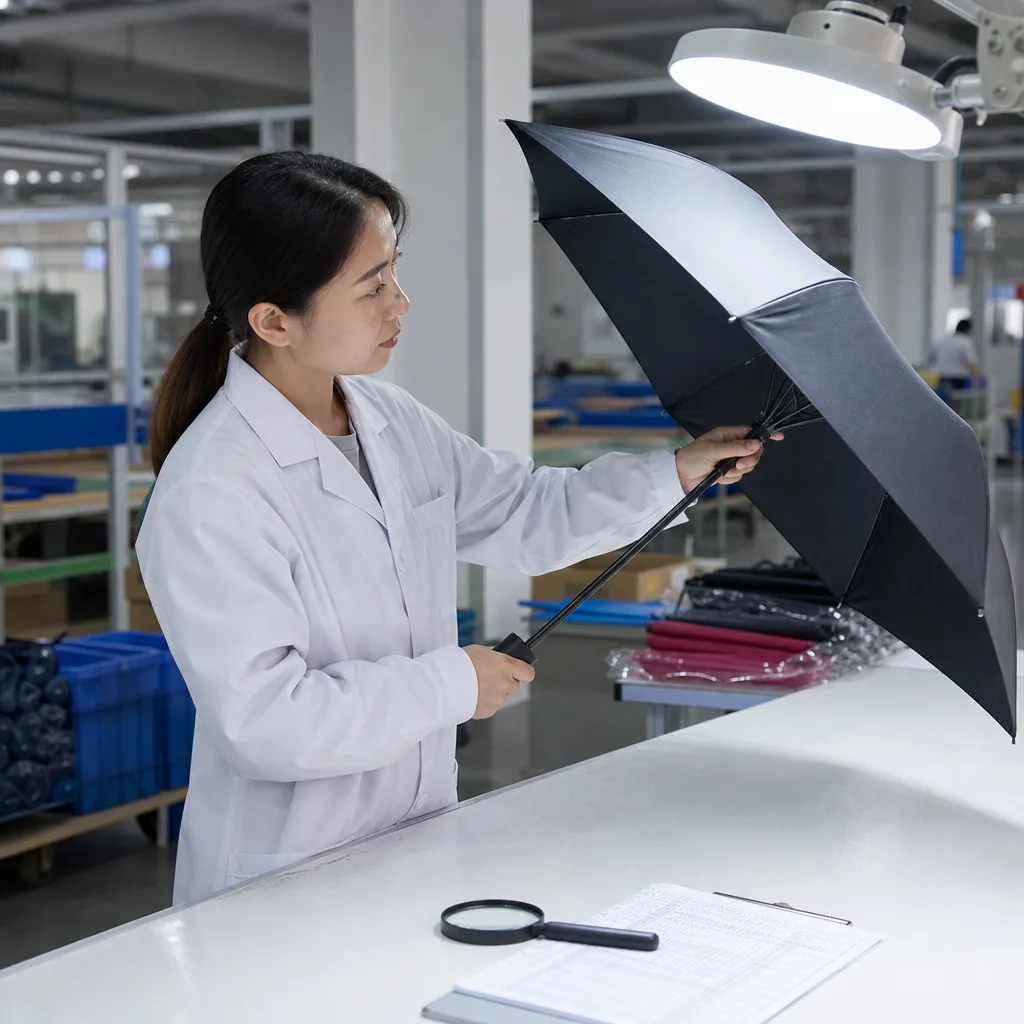
When an OEM order moves from sample approval to 10,000 pieces, small fabric-cutting errors become crooked tips, uneven tension, and leak-prone seams. On our cutting tables in Songxia, umbrella fabric cutting tolerances are controlled through matched panel templates, clean die edges, fabric relaxation checks, and seam allowance discipline for 190T and 210T pongee. The goal is simple: every canopy panel must sew, stretch, and sit on the frame the same way as the approved sample.
Why Canopy Cutting Accuracy Matters in OEM Orders
Canopy cutting accuracy is one of the first places an OEM umbrella order succeeds or fails, because every later process is forced to follow the cut panel. In umbrella canopy panel cutting, a 2–3 mm error on each gore may look harmless on the cutting table, but after 8 panels are sewn together that error can turn into visible wrinkling, uneven rib tension, or a canopy that pulls off-center when opened. If the panel is too small, the fabric overstretches between tips and the runner feels tight; if it is too large, the canopy sags and flaps in wind. On rain umbrellas, poor umbrella fabric cutting tolerances also affect waterproofing. When the seam line drifts or the crown area is distorted, water collects along puckered seams and can leak through needle holes even when 190T or 210T pongee has a decent water-repellent coating.
Tolerance control becomes more critical as rib count increases. An 8K umbrella gives each panel a relatively wide span, so small cutting deviations may be absorbed by sewing tension and final stretching. On 10K frames, the panels are narrower and the seam allowance must stay more consistent, usually around 6–8 mm depending on fabric weight and stitch setting. On 16K models, there is almost no forgiveness: one uneven panel can make the whole canopy twist, especially on straight umbrellas with 23", 27", or 30" arc sizes. In pongee umbrella manufacturing, fabric shrinkage after coating, sublimation, or heat-transfer printing must also be considered before cutting. A printed panel that is dimensionally stable in length but shrinks across the bias will not sit correctly on the rib layout, even if the frame itself passes inspection.
For OEM umbrella production, we normally define umbrella fabric cutting tolerances before mass cutting, not after the first failed inline inspection. Our standard practice at ZheBrella is to approve a cutting template from sealed samples, then check panel length, arc curve, notch position, and canopy seam allowance during the first bundle of production. For common 190T pongee golf umbrellas, a practical tolerance is often within ±1.5 mm on critical seam edges and tip points, while promotional PVC, POE, or EVA canopies may need different allowances because the material stretches, sticks, or deforms under blade pressure. If the order uses double-canopy vented windproof construction, the top and lower canopy panels must match not only the frame but also each other; otherwise the vent gap becomes uneven and wind performance drops. Accurate cutting is cheaper than repairing 3,000 wrinkled umbrellas after sewing.
Fabric Selection and Layup Before Cutting
Fabric choice sets the floor for umbrella fabric cutting tolerances before the cutting knife ever touches the lay. In pongee umbrella manufacturing, 190T polyester is lighter, softer, and easier to pack into compact 21" and 23" umbrellas, but it shifts more in multi-layer cutting and can grow slightly under tension. 210T pongee has a tighter hand and better opacity, so it behaves more predictably for 27" and 30" golf umbrellas, especially when panels carry screen printing or heat-transfer logos. For bulk OEM umbrella production, we do not treat the two fabrics the same: a 190T lay is kept lower, often 40–60 layers depending on coating, while 210T can usually run higher if the roll tension is stable. The wrong lay height creates panel mismatch, uneven canopy seam allowance, and twisted umbrella tips after sewing.
Grain direction is not a theory issue; it decides whether the finished canopy sits round or pulls into a potato shape. Each umbrella canopy panel cutting marker must align the panel centerline with the warp direction unless the design has a specific bias requirement, because pongee stretches differently across width and length. The coating side also has to face consistently during layup. Silver UV, black-out, Teflon water-repellent, and PU coatings all change friction between plies; if half the stack is face-up and half is face-down, the cutter will see drag variation and the panel edges will creep. Our standard practice at ZheBrella is to mark the coating side at roll opening, confirm it again at spreading, and keep shrinkage allowance separate for uncoated 190T, Teflon-treated 210T, and UPF 50+ coated fabrics.
Bulk rolls are inspected before cutting for three things that cause most production disputes: shade variation, coating defects, and usable width. Shade is checked roll-to-roll and within the roll under a D65 light box, because a navy 210T pongee canopy can show obvious panel color blocking after sewing if rolls are mixed carelessly. Coating defects include pinholes, streaks, cloudy PU, silver transfer marks, and water-repellent skips; these are flagged and cut around instead of being hidden in inside panels. Width consistency matters because many umbrella markers are tight: a roll sold as 58/60" but running 57.2" can steal the canopy seam allowance or force marker distortion. For stable umbrella fabric cutting tolerances, we also test shrinkage with steam or heat exposure when sublimation, heat transfer, or post-cut curing is involved, then adjust the marker before mass cutting starts.
Cutting Methods: Hand Knife, Die Cutting, and CNC
Hand knife cutting is still useful in OEM umbrella production, but only when the order is small, urgent, or not worth making a die for. A skilled cutter can stack 190T or 210T pongee in 30 to 60 layers, clamp the marker, and cut 21", 23", or 27" panels fast enough for a 500 to 2,000 piece promotional run. The weakness is tolerance drift. On slippery pongee or coated polyester, the lower layers can shift 1.5 to 3 mm if the stack is too high or the blade is dull. That sounds minor, but on an 8K umbrella it multiplies around the canopy and can create twisted tips, uneven skirt line, or seam puckering. For basic one-color panels with screen printing after sewing, hand cutting is acceptable. For tight umbrella fabric cutting tolerances, I limit stack height, require fresh blades, and check the first bundle against the paper pattern before sewing starts.
Die cutting gives the best balance of speed and repeatability for standard canopy shapes, especially retail programs that repeat the same 23" straight umbrella, 21" folding umbrella, or 30" golf umbrella across many colors. The setup cost is the steel-rule die, which may be modest for a simple 8K panel but higher for unusual arc shapes, scalloped edges, or panels with special notches for vented double-canopy construction. Once the die is approved, output is much faster than hand knife cutting, and panel variation is usually held within about ±1 mm if the fabric stack is controlled. This matters in pongee umbrella manufacturing because the canopy seam allowance is commonly 6 to 8 mm; if cutting eats 2 mm on one side, the sewer has little room to correct it. Die cutting is my preferred method for stable retail SKUs, repeat promotional programs, and any order where AQL 2.5 inspection will include canopy symmetry and tip alignment.
CNC cutting is slower per layer than die cutting but stronger for complex layouts, short development runs, and sublimation work where artwork placement matters more than raw speed. For digital sublimation panels, the cutter can follow printed registration marks so logos, gradients, or photographic artwork land correctly at the ribs and center cap. This is where umbrella canopy panel cutting becomes less about shape alone and more about matching print distortion, fabric shrinkage, and sewing allowance. CNC also avoids die cost, which helps when a buyer is testing several 16K fashion umbrellas or a vented golf umbrella with different upper and lower canopy shapes. Our standard practice at ZheBrella is to use CNC for sampling, pre-production validation, and complex sublimation layouts, then switch to die cutting once the pattern is frozen and volume justifies tooling. For demanding umbrella fabric cutting tolerances, CNC is not automatically better; calibration, vacuum hold-down, marker nesting, and fabric relaxation time still decide the final result.
Seam Allowance, Panel Matching, and Canopy Fit Checks
Seam allowance is the first place bulk canopies go wrong, because a 2 mm error per seam becomes a visible fit problem after 8 or 10 panels are joined. For most pongee umbrella manufacturing, we control canopy seam allowance at 6–8 mm depending on fabric weight, stitch type, and whether the edge is single-needle locked or double-stitched for golf umbrellas. During umbrella canopy panel cutting, panel edge alignment must stay within about ±1.5 mm on 190T and 210T pongee; coated fabrics like Teflon-treated polyester or UPF 50+ black-coated pongee need tighter handling because layers can slide under the cutting die. If panels are cut narrow, the canopy pulls tight across fiberglass ribs and creates stress at the tips. If panels are cut wide, the canopy sags between steel ribs and looks cheap even when the frame is acceptable. Good umbrella fabric cutting tolerances are not cosmetic paperwork; they decide whether the sewing line can maintain speed without constant trimming and correction.
Notch placement is another hard control point because it tells the sewing operator where the panel crown, middle, and rib-tip positions should meet. On a 23 inch 8K umbrella, a notch drifting 3 mm from the approved marker can twist the canopy after closing, especially on auto-open and auto-open-close frames where spring force exposes imbalance quickly. For 10K and 16K constructions, the risk is greater because more seams must distribute tension evenly around the runner and tips. Top cap hole positioning also needs inspection before sewing, not after final assembly. We normally keep the center hole within ±2 mm from the panel-set centerline and verify that reinforcement patches are aligned before punching. A mislocated cap hole causes the canopy to lean to one side, making rib lengths appear wrong even when the fiberglass or steel frame is built correctly. In OEM umbrella production, this kind of false frame complaint wastes time because the real defect started at cutting.
Fit checks should happen on a confirmed production frame, not only on a flat paper pattern. After first-article sewing, the canopy is mounted on the exact 21 inch, 23 inch, 27 inch, or 30 inch frame specified in the order, then checked for tip tension, rib pocket position, seam line straightness, and cap seating. For double-canopy vented windproof models, both upper and lower layers must be checked together because vent overlap and mesh spacing can change the pull on fiberglass ribs during wind testing. A practical factory rule is to inspect the first 3–5 sewn canopies from each cutting lot before releasing full sewing output, then record issues under AQL 2.5 inline inspection. Proper umbrella fabric cutting tolerances reduce rework at rib tying, cap fixing, and final opening tests, where labor is more expensive than correcting a marker or cutting stack early. This is especially important for FOB or DDP orders with fixed delivery windows, because assembly rework can easily consume 2–4 production days.
QC Records Buyers Should Request
The most useful QC record is the first-piece cutting approval, because it freezes the real cutting standard before hundreds of layers are stacked. For umbrella canopy panel cutting, buyers should ask for the approved paper pattern or CAD marker, the measured panel width at crown and hem, rib-tip distance, notch location, and canopy seam allowance, usually 7–10 mm depending on stitch type and fabric stretch. The record should show comparison against the approved PP sample, not just the tech pack, because many PP samples are adjusted after frame fitting. In pongee umbrella manufacturing, 190T and 210T polyester behave differently after Teflon coating, UV coating, or digital printing heat exposure, so the factory should record whether panels were measured before or after relaxation. If the order is for 23" auto-open, 27" golf, or 30" double-canopy models, the tolerance window should be tied to the frame size and rib count, such as 8K, 10K, or 16K, not written as one generic umbrella standard.
Fabric roll inspection records matter just as much as cutting reports, especially for OEM umbrella production where color and coating consistency are part of the brand requirement. Buyers should request the incoming fabric inspection sheet showing roll number, width, GSM, color shade, coating side, water repellency result, defect mapping, and usable yardage. For printed umbrellas, the record should identify screen print, heat transfer, or sublimation lots, because print shrinkage can move logos away from the panel centerline. Our standard practice at ZheBrella is to quarantine rolls with shade variation beyond the approved lab dip or PP sample before cutting, rather than mixing them inside one PO. The cutting room should also keep bundle tickets showing quantity per size, roll origin, panel direction, and operator ID. This is how a buyer traces a crooked logo or tight canopy back to a specific cutting table instead of arguing after final inspection.
In-line panel checks and final canopy fit reports are the bridge between umbrella fabric cutting tolerances and AQL 2.5 inspection. Ask for in-line measurement logs taken every 200–500 panels, with actual readings for panel length, arc, notch alignment, and seam allowance after sewing. A final canopy fit report should confirm the canopy opens smoothly on the approved frame, rib tips sit evenly, the top cap is centered, and there is no excessive tension, sagging, twisting, or exposed stitch holes under light spray testing. For windproof double-canopy umbrellas, the report should also check vent overlap and balance, because a 3–5 mm cutting error can make the vent flap lift unevenly in a 50+ mph wind-tunnel test. At shipment stage, the third-party or buyer inspection under AQL 2.5 should compare finished goods against the PP sample, BOM, and these QC records. Without that paper trail, final inspection only finds defects; it cannot prove where the cutting process failed.
Frequently Asked Questions
What cutting tolerance is reasonable for umbrella canopy panels?
For most OEM umbrellas, buyers should discuss panel length, seam allowance, and notch position tolerances with the factory before sampling. Tighter tolerances are usually needed for 16K frames, double-canopy structures, and all-over printed canopies.
Does 210T pongee require different cutting control than 190T pongee?
Yes. 210T pongee is denser and often used for premium umbrellas, so panel matching and seam tension are more visible. Factories should confirm shrinkage, coating direction, and cutting stability during pre-production.
What panel cutting tolerance is usually acceptable for bulk umbrella canopy production?
For most OEM umbrella orders, buyers typically approve a panel cutting tolerance around ±1 to ±2 mm, depending on canopy size and fabric type. Tighter control is often required for printed canopies or alternating color panels because mismatch is more visible at the seams.
Does 190T or 210T pongee require different cutting controls during production?
Yes. 210T pongee is usually denser and can behave slightly differently during spreading and cutting, so factories often verify blade sharpness, template wear, and stack height more frequently. In bulk runs, this helps keep panel shape stable and reduces sewing distortion.
How do factories check seam allowance consistency before full-scale sewing starts?
A common method is to cut and sew a first article sample, then measure several panels and seam positions against the approved template before releasing mass production. For export orders, inline QC may recheck measurements every few hundred pieces per color to catch drift early.
Looking to Launch Your Custom Umbrella Line?
ZheBrella is a Zhejiang-based OEM/ODM umbrella manufacturer with 17 years of export experience. Free design, low MOQ from 100 pieces, windproof construction, full-color print.
Get Free Quote Now »People Also Search For
Related Articles
Umbrella Canopy Cutting Tolerances for Consistent Production
See how panel cutting tolerance, fabric shrinkage, and marker layout affect canopy fit, print alignment, and rework in O...
Read More »
Umbrella Canopy Panel Cutting Tolerances for OEM Production
Learn how panel cutting tolerances, fabric relaxation, and die control affect canopy fit, print alignment, leak risk, an...
Read More »
Umbrella Canopy Cutting Tolerances for OEM Production
Learn canopy cutting tolerances, panel grain control, and sewing allowances that keep 190T/210T pongee umbrellas fitting...
Read More »