Reflective Safety Umbrellas for Campus and Fleet Programs
Campus security teams, utility crews, fleet drivers, and event staff need umbrellas that make people visible without turning every unit into a bulky roadside tool. On our Songxia production floor, the difference between reflective safety umbrellas that hold up and ones that fail early often comes down to how the reflective piping is sewn, which panel prints can survive flexing, how the fabric sheds water, and whether the frame build matches real field use.
Where Reflective Umbrellas Fit B2B Programs
The strongest buyers for reflective safety umbrellas are organizations that move people through dark, wet, or traffic-adjacent environments on a regular schedule. Universities use them for campus police, residence-life teams, parking staff, shuttle coordinators, and student orientation kits because a black umbrella disappears under streetlights, especially when rain hits the lens of a driver. Logistics fleets and last-mile delivery teams need a different kind of visibility: drivers walking between docks, vans, and customer entrances with one hand often occupied by a scanner or package. Utility crews, security contractors, hotel valet teams, and outdoor event staff have the same problem—rain protection is useful only if the person remains visible from the side, front, and back. For these programs, reflective tape placement matters more than a clever gadget. A 23" or 27" canopy with reflective trim around the edge gives a moving light signature at shoulder height, while printed panels keep department names, fleet numbers, or sponsor logos readable.
Visibility, coverage, and durability should drive the specification before anyone discusses novelty features like LED handles or unusual shapes. In factory terms, a reflective trim umbrella is only as good as the base umbrella under it. A 190T pongee canopy is adequate for many promotional programs, but 210T pongee with a water-repellent coating sheds rain faster and feels more retail-grade. For crews working around vehicles, I prefer fiberglass ribs over painted steel ribs because fiberglass flexes instead of staying bent after a gust; 8K is standard, 10K gives a rounder canopy and better load distribution, and 16K is usually overkill unless the buyer wants a premium executive look. A double-canopy vented construction is worth considering for exposed campuses, ports, and event lots because it can survive 50+ mph gusts in a controlled wind-tunnel test when the shaft, runner, and rib joints are properly matched.
High visibility umbrellas also work well as safety promotional umbrellas because they have a real job after the event ends. A university admissions office may want custom rain umbrellas for visiting families, but facilities management will care about AQL 2.5 inspection, seam strength, reflective tape adhesion, and whether the logo ink cracks after repeated wet folding. Fleet buyers usually ask for auto-open 23" stick umbrellas for quick deployment, while security and utility teams may choose 27" manual golf umbrellas for better shoulder and equipment coverage. Our standard practice at ZheBrella is to confirm use case before quoting: indoor handout, daily staff issue, or field-duty equipment all need different frames and packing. For most B2B orders, MOQ starts around 500–1,000 pieces depending on printing and reflective material, with bulk lead times commonly 25–35 days after artwork approval, plus FOB or DDP transit planning.
Reflective Options: Piping, Tape, and Printed Panels
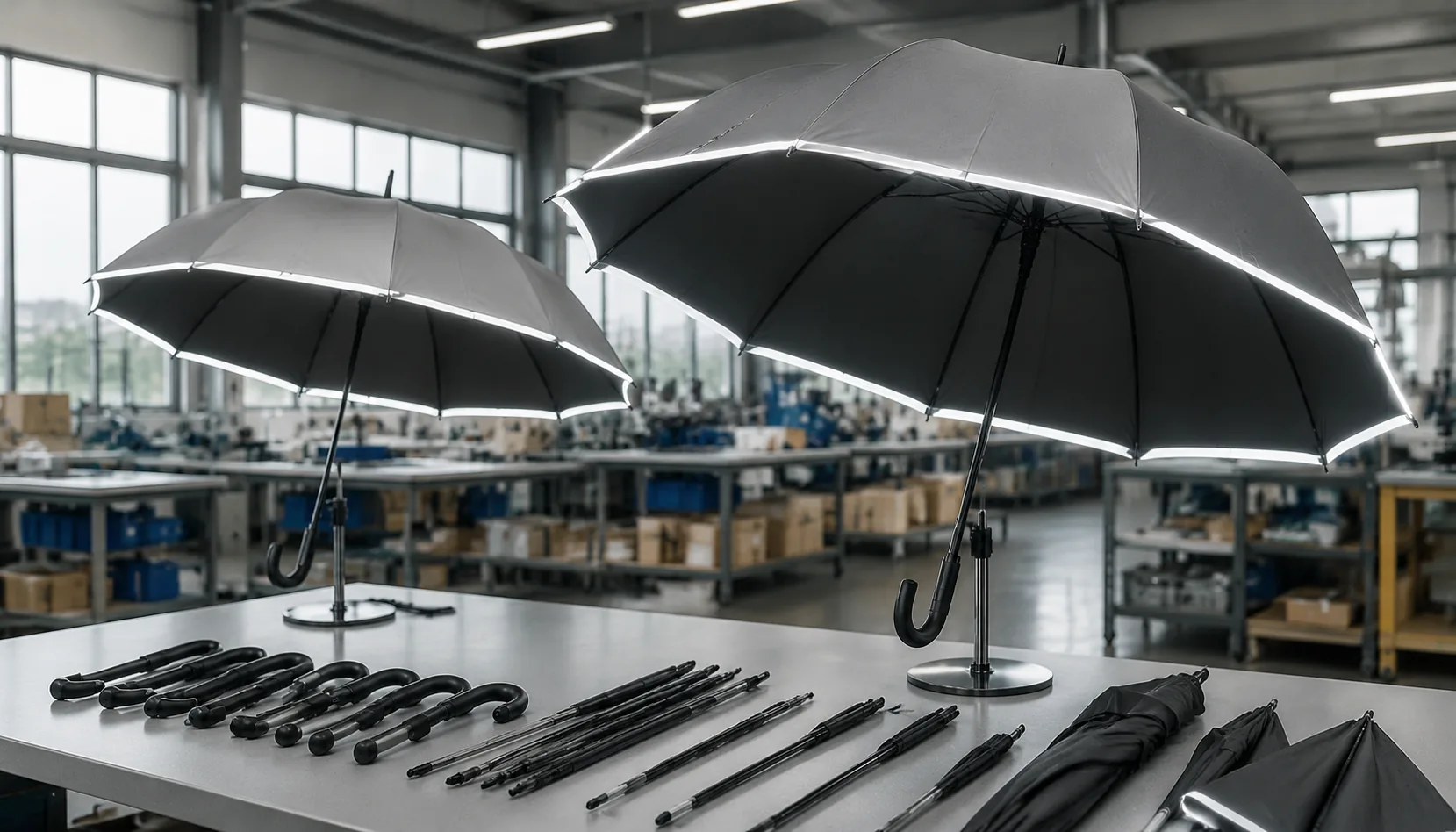
Reflective edge piping is the cleanest option when the buyer wants visibility without turning the umbrella into a road-cone graphic. We sew 3–5 mm reflective piping into the canopy seam or along the outer hem, usually on all 8 panels so the outline reads from side and rear angles when a student or driver is walking away from headlights. On 23" and 27" custom rain umbrellas, hem piping gives a 360-degree ring that is visible even when the printed logo faces the wrong direction. The limitation is surface area: piping flashes well under headlights, but it does not create a large warning block. For campus security, parking attendants, and shuttle teams, I normally pair reflective piping with a bright 190T or 210T pongee canopy in yellow, lime, or orange rather than black, because reflective material only works when light hits it directly.
Heat-transfer reflective tape gives stronger nighttime performance because it can be placed in wider 10–25 mm strips across selected panels. On an 8-panel canopy, the most practical layouts are four alternating vertical strips from crown to hem, or a broken chevron pattern on the rear-facing panels. Full continuous tape across every seam looks good in a drawing but can stiffen folding, especially on compact 21" auto-open-close frames where the fabric stack is already tight. For high visibility umbrellas used by fleet inspectors or event parking crews, I prefer tape on panels 2, 4, 6, and 8, with the main logo on a non-taped panel to avoid adhesion conflicts. Tape must be applied after panel cutting and before final sewing, with controlled temperature and dwell time; cheap tape will crack after repeated wet folding.
Screen-printed reflective graphics are best when the safety message itself needs to be visible: school name, “SECURITY,” route number, or a fleet logo. The reflective ink sits flatter than tape and allows larger artwork on one or two panels, but it is less bright than certified reflective film and needs careful mesh selection to keep the particles from clogging. For reflective safety umbrellas, we usually keep the print away from high-flex fold lines and place large graphics on opposite panels so the umbrella reads from both rear and side angles. Sleeve branding is worth specifying too: a reflective trim umbrella sleeve with a printed department name is visible when umbrellas are stored in buses, guard booths, or dorm entrances. Safety promotional umbrellas should treat the sleeve as part of the system, not an afterthought, because the canopy is not always open when the user needs to identify issued gear.
Recommended Canopy and Frame Specifications
For campus and fleet programs, the canopy should start with 190T or 210T pongee, not thin polyester that sags after one season. 190T is enough for most safety promotional umbrellas, especially 23" and 27" models where budget matters, but 210T gives a tighter hand feel, cleaner panel tension, and better print registration for logos or department names. Specify a durable water-repellent coating, with Teflon treatment if the umbrella will be issued to security teams, shuttle drivers, parking staff, or maintenance crews who use it daily. Reflective safety umbrellas also need reflective binding or segmented reflective tape sewn into the panel seams; printing reflective ink on top of fabric is cheaper, but it does not last as well after repeated wet folding.
For the frame, I normally recommend fiberglass ribs before upgrading anything else. Fiberglass flexes under gusts instead of taking a permanent bend like low-grade steel, and it is the correct choice for high visibility umbrellas used across open parking lots, loading docks, and school walkways. An 8K structure is practical for 21" folding umbrellas and standard 23" straight umbrellas, while 16K is better for executive-style 27" or 30" golf umbrellas where canopy stability and a rounder profile matter. If the buyer wants a reflective trim umbrella for field supervisors or traffic control staff, a 16K fiberglass rib set with reinforced tips is worth the added cost because the umbrella will be opened and closed hundreds of times in wet, windy conditions.
Shaft material should match the use case, not just the target price. Steel shafts are strong and economical for straight custom rain umbrellas issued from a facilities office or vehicle pool, but they add weight and can rust if the plating is poor. Aluminum shafts reduce weight for student or staff carry programs, though they are less forgiving under abuse. For exposed sites, a double-canopy vented windproof build is the safest specification: air escapes through the upper canopy, reducing inversion risk, and a fiberglass rib-and-stretcher system can usually survive controlled wind-tunnel tests around 50+ mph when the sewing tension and runner fit are correct. Our standard practice at ZheBrella is to confirm rib count, shaft diameter, runner material, and canopy coating during pre-production sampling before approving bulk cutting.
Mechanism, Size, and Handle Choices for Field Use
For staff distribution, the straight auto-open stick format is usually the least troublesome to manage, especially when you are issuing reflective safety umbrellas by the hundred. A 23-inch stick umbrella gives enough canopy coverage for daily walking between parking lots, loading zones, and campus buildings without becoming awkward in an office bag. The auto-open mechanism is fast enough for field use, but it is still simple to repair if a spring or runner fails. From a production standpoint, a straight shaft also gives you a cleaner surface for reflective trim umbrella layouts, logo placement, and screen printing on the panels. If the program is for security teams, shuttle drivers, or facilities staff, I would lean toward a stick umbrella before any folding format because it holds up better under repeated open-close cycles and does not feel flimsy in hand.
Golf umbrellas make sense when the priority is visibility and coverage rather than portability. A 27-inch golf umbrella with fiberglass ribs and a double-canopy vent is better for windy campus crossings, outdoor gate checks, and fleet drivers who stand outside in weather for long periods. The larger frame gives more room for high visibility umbrellas with reflective tape on alternating panels, which matters when the umbrella is part of a safety uniform rather than a casual giveaway. In my experience, golf-size sticks are also better for custom rain umbrellas used by maintenance crews because the canopy stays higher off the shoulders and reduces contact with backpacks or radios. The tradeoff is obvious: they are not as easy to carry all day, so they work best when the umbrella stays with the employee in a vehicle or at a fixed post.
Compact folding styles are useful only when the program needs pocketable convenience, not when the main goal is durability. A 3-fold or 2-fold frame with a wrist strap fits commuter staff, visiting contractors, and temporary crews who need a light rain backup, but it is not my first choice for safety promotional umbrellas that will see rough handling. The smaller frame usually limits the size of reflective panels, and the shorter shaft makes it harder to print large branding or warning graphics clearly. For handles, EVA grips are the best option if the umbrella will be carried for long shifts, because they stay comfortable when wet and do not turn slick the way hard plastic can. Plastic J handles are still common on stick umbrellas because they hang well on carts or hooks, and a wrist strap is worth specifying on almost every field-use order.
Ordering, Testing, and Delivery Checks
For reflective safety umbrellas, lock the specification before discussing price: size, mechanism, canopy fabric, reflective layout, and packing method all change cost and lead time. For campus and fleet programs, the most common builds are 23" auto-open straight umbrellas for staff handout, 27" golf umbrellas for security or parking teams, and compact 21" auto-open-close units for drivers. MOQ is usually 500 pieces per design for standard 190T pongee with one-color logo printing, but reflective tape placement, custom PMS canopy colors, or mixed-site carton labeling can push practical MOQ to 1,000 pieces. I would not approve bulk production from a digital mockup alone; request a physical pre-production sample showing the reflective trim umbrella layout, logo position, handle color, sleeve, and carton marks. For custom rain umbrellas using silver reflective tape or reflective piping, sample approval should include photos under daylight and low-beam vehicle headlights from 30 to 50 feet, not just studio lighting.
Reflective material has to be tested as a safety component, not decoration. The factory should confirm tape width, usually 10 mm, 15 mm, or 20 mm, and whether it is sewn into canopy seams, edge binding, or applied as heat-transfer film. Sewn reflective trim is more durable for high visibility umbrellas, but it must be checked for needle holes, seam puckering, and water leakage after a spray test. Heat-transfer reflective film looks cleaner on promotional panels but needs adhesion testing after wet rubbing, folding, and 24-hour recovery. During production, our standard practice at ZheBrella is to inspect rib riveting, runner action, tips, cap alignment, printing registration, and reflective placement under AQL 2.5 for major defects. For windproof models, sample testing should include repeated open-close cycles, inversion recovery on fiberglass ribs, and at least a controlled fan or wind-tunnel check if the buyer claims 40 or 50+ mph performance.
Final delivery checks matter because safety promotional umbrellas are often distributed to many sites with no time for rework. Before shipment, run carton drop checks on master cartons from corner, edge, and face positions, especially when shipping 27" or 30" golf umbrellas with long shafts. Confirm inner polybag warning text, carton quantity, gross weight, destination labels, and any site-specific packing list. Normal lead time is about 7 to 10 days for sampling, 25 to 35 days for bulk production after sample approval, and longer if reflective tape, UPF 50+ coating, or custom handles are not in stock. FOB Ningbo or Shanghai works well when the buyer has a freight forwarder and can consolidate other goods. DDP is usually better for multi-site campus or fleet rollouts because duties, customs clearance, and last-mile delivery are handled in one landed cost, but the factory needs exact addresses, delivery windows, and carton-level allocation before production packing begins.
Frequently Asked Questions
Can reflective umbrellas use both safety trim and a full-color logo?
Yes. Most buyers place reflective piping around the canopy edge and print the logo on one or two panels. Keep the logo away from seam lines to avoid distortion.
Which frame is best for reflective umbrellas used outdoors daily?
An 8K or 16K fiberglass rib frame is usually better than all-steel ribs because it flexes in gusts. For larger safety umbrellas, a double-canopy windproof design adds stability.
Which reflective option holds up better in daily fleet or campus use: piping or panel print?
Reflective piping usually lasts longer in repeated open-close cycles because it sits on the seam instead of across the canopy surface. Panel prints give more visible area at distance, but buyers often choose piping for everyday driver, parking, and patrol programs where abrasion is higher.
What canopy size works best for utility crews and event staff carrying radios or small bags?
A 27 to 30 inch canopy is the most common range for active staff because it balances coverage and mobility. For two-person coverage at checkpoints or vehicle handoff points, many buyers move up to a 30 to 32 inch golf-style frame.
What are typical OEM terms for reflective safety umbrellas with custom markings?
For custom reflective umbrellas, MOQ is commonly 500 to 1,000 pieces per design depending on canopy material, reflective method, and handle choice. Sample time is often 7 to 10 days, with bulk production around 35 to 50 days after artwork approval.
Looking to Launch Your Custom Umbrella Line?
ZheBrella is a Zhejiang-based OEM/ODM umbrella manufacturer with 17 years of export experience. Free design, low MOQ from 100 pieces, windproof construction, full-color print.
Get Free Quote Now »People Also Search For
Related Articles
Reflective Safety Umbrellas for Corporate and Campus Programs
Specify reflective safety umbrellas with strip placement, canopy fabric, rib materials, print methods, and inspection ch...
Read More »Custom Reflective Umbrellas for Night Safety Programs
Plan reflective umbrellas with the right tape width, fabric, rib build, and AQL checks for safety campaigns, schools, ni...
Read More »
Reflective Safety Umbrellas for Commuter and Campus Programs
Plan safer branded umbrellas with reflective trim, canopy color, rib specs, and printing choices that balance visibility...
Read More »